
 CATEGORIES
- ORGANIC COMPOUNDS(1240)
- INORGANIC COMPOUNDS(1103)
- Mineral Acids(51)
- Chelates(3)
- Elements(136)
- Salts(593)
- Oxides(120)
- Hydroxides(36)
- Hydrides(15)
- Other(19)
- Nanoparticles(3)
- Standard solutions(126)
- LAB EQUIPMENT(5176)
- *(1)
- Organic Synthesis(438)
- Industry(783)
Language
US version allows shipping to all available destinations


 MANUFACTURER
Molecular Sieves 3A 1-3mm
Regular price:
Regular price:
product unavailable
add to wish list
0


Description
Molecular Sieves 3A (1–3 mm Beads)
Other Names: Molecular Sieve 3A, Zeolite 3A, K-LTA, Potassium-Exchanged Zeolite A, Potassium-Sodium Aluminosilicate
Chemical Formula: KnNa12−n[(AlO2)12(SiO2)12] · xH2O
Molar Mass: Not uniquely defined because the degree of K+/Na+ exchange and hydration can vary
CAS Number: 308080-99-1
Framework Type: LTA (Linde Type A)
Nominal Pore Size: Approximately 3 Å (0.3 nm)
Particle Size: 1–3 mm beads
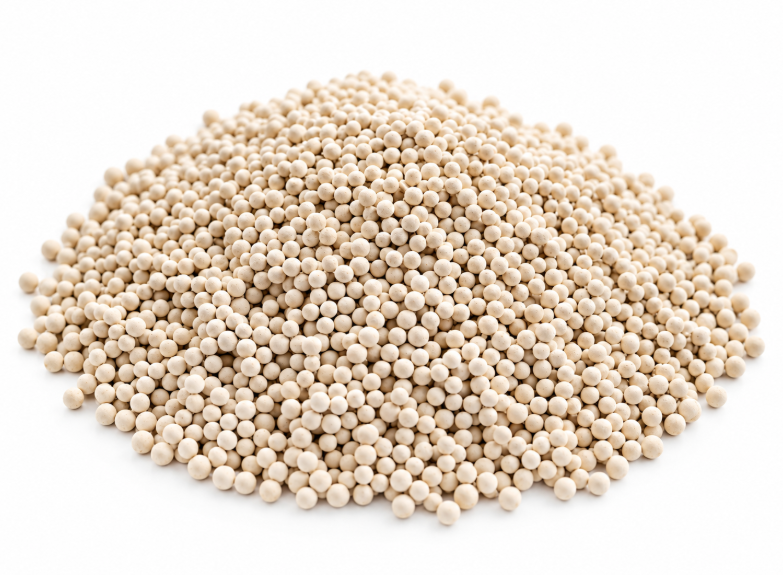
Appearance: Porous solid spherical beads
Odor: Odorless
SMILES: Not applicable; molecular sieve 3A is an extended crystalline aluminosilicate framework and does not have a unique molecular SMILES representation
Regeneration:
Molecular sieves 3A can be regenerated by heating in a drying cabinet at temperatures between 200–300 °C, or through pressure change or rinsing methods.
Molecular Sieve 3A is a synthetic crystalline aluminosilicate belonging to the LTA zeolite framework family. The framework is constructed from corner-sharing SiO4 and AlO4 tetrahedra that form a three-dimensional system of cages connected through eight-membered oxygen rings. Substitution of Al3+ for Si4+ creates a negatively charged framework, which is electrically balanced by extra-framework alkali-metal cations.
The 3A form is produced by partial replacement of sodium ions in zeolite A with the larger potassium ion. The potassium cations occupy positions close to the eight-membered ring windows and reduce the effective pore aperture from approximately 4 Å in Na-LTA (4A) to approximately 3 Å in K-containing LTA. This controlled aperture is responsible for the molecular-sieving behavior of the material. Small molecules such as water can enter the internal microporous structure, whereas many larger molecules are sterically excluded.
Molecular sieve 3A has a particularly strong affinity for water because of the highly polar aluminosilicate framework and the presence of charge-balancing cations. Experimental adsorption studies have demonstrated substantial water uptake and rapid water adsorption over a broad range of conditions. Its combination of hydrophilicity and restricted pore opening makes 3A especially useful when water must be removed while minimizing adsorption of larger components of a gas or liquid stream.
Chemical and physical properties
Molecular sieve 3A possesses the LTA topology characteristic of zeolite A. The structure contains larger α-cages and smaller sodalite-type β-cages interconnected through defined ring systems. Molecular transport into the main adsorption cavities occurs primarily through eight-membered oxygen-ring windows.
The effective pore aperture is approximately 3 Å. Scientific studies comparing different ion-exchanged LTA zeolites show that K-LTA corresponds to the 3A form, while Na-LTA and Ca,Na-LTA exhibit effective apertures of approximately 4 Å and 5 Å, respectively. The pore-size modification results directly from the size and position of the charge-balancing cations.
The framework has a Si/Al ratio close to 1, giving zeolite A a high concentration of negatively charged framework sites and exchangeable cations. These structural characteristics produce strong electrostatic interactions with polar molecules, particularly water.
Water molecules, with dimensions small enough to pass through the approximately 3 Å aperture, can diffuse into the internal cavities and adsorb at energetically favorable sites associated with framework oxygen atoms and extra-framework cations. Larger molecules may be strongly restricted or completely excluded from the internal pore system.
Water adsorption is temperature- and partial-pressure-dependent. Experimental studies of 3A molecular sieves have demonstrated measurable steam adsorption even at elevated temperatures, and adsorption models indicate that both equilibrium capacity and mass-transfer behavior are important for practical drying and sorption-enhanced processes.
The 1–3 mm bead form provides a macroscopic particle geometry suitable for packed adsorption beds and laboratory drying columns. The beads contain the microporous LTA structure responsible for selective adsorption, while the macroscopic particle dimensions influence pressure drop and overall mass-transfer characteristics during operation.
Molecular sieve 3A is a non-volatile inorganic solid and therefore does not have conventional boiling and melting points comparable with molecular substances. At sufficiently high temperatures, structural dehydration and ultimately framework degradation occur rather than ordinary boiling.
Applications
Molecular sieve 3A is widely used as a selective desiccant for removing water from technical gases and liquid chemical streams. Its approximately 3 Å pore aperture allows preferential adsorption of water while limiting penetration of many larger molecules into the internal zeolite cavities.
It is particularly suitable for drying hydrocarbon-containing process streams where excessive co-adsorption of larger hydrocarbon molecules is undesirable. The material can be used in fixed-bed adsorption systems for purification and moisture control in chemical, petrochemical and gas-processing operations.
Molecular sieve 3A is also used for drying laboratory and industrial solvents and reagents when selective removal of residual water is required. The restricted pore opening can provide an advantage over larger-pore molecular sieves when preservation of larger molecular components is important.
In chemical engineering research, 3A molecular sieves are investigated for steam adsorption and sorption-enhanced reaction processes. Removal of water formed during a chemical reaction can modify the reaction environment and, in suitable equilibrium-limited systems, increase conversion toward the desired products.
The material is also extensively studied as a model microporous adsorbent for investigations of diffusion, adsorption kinetics, molecular sieving, cation effects and transport through zeolite pore apertures.
Scientific references
- Reed, T. B.; Breck, D. W. “Crystalline Zeolites. II. Crystal Structure of Synthetic Zeolite, Type A.” Journal of the American Chemical Society, 1956, 78, 5972–5977. DOI: 10.1021/ja01604a002.
- Montanari, T.; Salla, I.; Busca, G. “Adsorption of CO on LTA zeolite adsorbents: An IR investigation.” Microporous and Mesoporous Materials, 2008, 109, 216–222. DOI: 10.1016/j.micromeso.2007.04.045.
- van Kampen, J.; Boon, J.; van Sint Annaland, M. “Steam adsorption on molecular sieve 3A for sorption enhanced reaction processes.” Adsorption, 2021, 27, 577–589. DOI: 10.1007/s10450-020-00283-8.
- Chaibi, A.; Boucheffa, Y.; Bendjaballah-Lalaoui, N. “TGA investigation of water and ethanol adsorption over LTA zeolites.” Microporous and Mesoporous Materials, 2021, 324, 111285. DOI: 10.1016/j.micromeso.2021.111285.
- International Zeolite Association Structure Commission. Database of Zeolite Structures: LTA Framework Type and Linde Type A Reference Material.
Safety Information:
-
Handling: Avoid inhalation of dust. Use in a well-ventilated area.
-
Storage: Store in a tightly sealed container in a cool, dry place to prevent moisture adsorption before use.
*Note: The information provided is based on general data. Always refer to the Safety Data Sheet (SDS) provided by the supplier for detailed and accurate information.*