Manganese Chelate 13% (Mn-EDTA)
Other Names: Manganese disodium EDTA, Disodium manganese ethylenediaminetetraacetate, EDTA manganese disodium salt, Mn-EDTA, EDTA-MnNa2
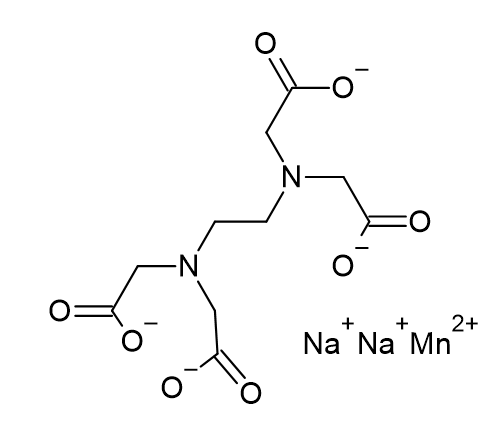
Chemical Formula: C10H12MnN2Na2O8 (anhydrous); commonly encountered as a hydrated salt
Molar Mass: 389.13 g/mol (anhydrous); approximately 425.16 g/mol for the dihydrate
CAS Number: 15375-84-5
Manganese Content: approximately 13% Mn
SMILES: C(CN(CC(=O)[O-])CC(=O)[O-])N(CC(=O)[O-])CC(=O)[O-].[Na+].[Na+].[Mn+2]
Appearance: Solid manganese(II) coordination compound
Manganese chelate 13% is a manganese(II) coordination compound in which Mn2+ is complexed by ethylenediaminetetraacetate (EDTA). EDTA is a multidentate ligand containing two nitrogen donor atoms and four carboxylate groups and is capable of strongly coordinating manganese ions. The resulting Mn(II)-EDTA complex is significantly more stable in aqueous solution than uncomplexed manganese ions under many chemical conditions. Experimental studies have reported formation constants for Mn(II)-EDTA corresponding to log K values of approximately 13.8–13.9, demonstrating the strong affinity of EDTA for Mn2+.
The designation “13% Mn” refers to the mass fraction of elemental manganese in the material. Hydrated disodium manganese EDTA is particularly consistent with this specification: the calculated manganese fraction of the dihydrate is approximately 12.9% by mass. Commercial material may contain different amounts of hydration water, so the exact molecular mass and manganese percentage can vary slightly between grades. The anhydrous disodium manganese EDTA compound has the molecular formula C10H12MnN2Na2O8 and a molecular mass of 389.13 g/mol.
Chemical and physical properties
Mn(II)-EDTA is an ionic coordination complex containing manganese in the +2 oxidation state. In the EDTA complex, the ligand surrounds the metal ion through multiple donor atoms, substantially modifying the chemical behavior of manganese compared with free Mn2+. EDTA has been described experimentally as forming a particularly stable complex with Mn2+ and can occupy the manganese coordination sphere through its nitrogen and carboxylate donor groups.
The coordination chemistry of manganese and EDTA is structurally diverse. Crystallographic investigations of manganese–EDTA compounds demonstrate that fully deprotonated EDTA4− can coordinate manganese through multiple donor sites and can participate in extended manganese-carboxylate structures. The exact solid-state coordination geometry depends on counterions, hydration and crystallization conditions.
Chelation also affects the oxidation chemistry of manganese. Experimental studies of aqueous Mn(II) oxidation have shown that EDTA strongly complexes Mn2+ and can markedly alter its oxidation rate and reaction pathway. The redox chemistry of manganese-EDTA complexes has consequently been investigated in both classical electrochemical studies and modern oxidation-process research.
Applications
Manganese EDTA is used in coordination-chemistry research as a defined source of complexed Mn(II) and as a model system for studying metal-ligand equilibria, chelate stability, ligand exchange and manganese coordination geometry.
It is also employed in analytical and electrochemical research involving manganese. The well-defined complexation equilibrium between Mn2+ and EDTA makes Mn-EDTA systems useful for investigating complexometric reactions, oxidation-reduction equilibria and metal-ion speciation. The Mn(II)-EDTA/Mn(III)-EDTA redox system has been characterized experimentally by potentiometric methods.
Mn(II)-EDTA is additionally studied in environmental and advanced oxidation chemistry. Research has demonstrated that EDTA complexation can influence the reaction of Mn(II) with molecular oxygen and can modify manganese-mediated redox pathways. More recent studies have investigated Mn(II)-EDTA in ferrate-based oxidation systems, where ligand coordination changes manganese intermediate stability and electron-transfer pathways during contaminant degradation reactions.
Scientific references
- PubChem. Disodium manganese EDTA, CID 51965. Molecular formula, molecular mass, CAS number and canonical SMILES.
- Rates of Abiotic Mn(II) Oxidation by O2: Influence of Various Multidentate Ligands at High pH. Environmental Science & Technology. Study of Mn(II)-EDTA complex stability and oxidation behavior.
- Synthesis, structure and magnetic properties of a two-dimensional manganese(II) complex with a maximum denticity of ethylenediaminetetraacetic ligand. Inorganica Chimica Acta, 2011, 376, 112–117. DOI: 10.1016/j.ica.2011.06.009.
- Tanaka N., Shirakashi T., Ogino H. The Oxidation-Reduction Potential of the System of Mn(II)EDTA-Mn(III)EDTA Complexes and the Stability Constant of Mn(III)EDTA Complex. Bulletin of the Chemical Society of Japan, 38(9), 1515–1517. DOI: 10.1246/bcsj.38.1515.
- Oriented redox pathways of Fe(VI) and Mn(II) by ligand engineering towards different reactive intermediate generation and micropollutant degradation. Chemical Engineering Journal, 2026. DOI: 10.1016/j.cej.2026.172809.
Safety
Hazard Statements
None
Precautionary Statements
None
Handling and Storage
Storage Conditions: Store in a well-ventilated area, away from sources of heat and open flames. Keep container tightly sealed. Protect from moisture. Handling Precautions: Avoid inhalation of vapors or mist and skin contact. Ensure appropriate protective equipment is used, including gloves and eye protection. Ensure proper ventilation when handling.



 "Pin It")