
 CATEGORIES
- ORGANIC COMPOUNDS(1135)
- INORGANIC COMPOUNDS(1055)
- Mineral Acids(51)
- Chelates(3)
- Elements(130)
- Salts(556)
- Aluminium(18)
- Ammonium(51)
- Antimony(4)
- Barium(20)
- Bismuth(5)
- Caesium(9)
- Cadmium(2)
- Calcium(33)
- Cesium(3)
- Copper(22)
- Cobalt(13)
- Chromium(11)
- Lead(14)
- Lanthanum(12)
- Lithium(15)
- Manganese(12)
- Sodium(151)
- Silver(7)
- Potassium(54)
- Zinc(16)
- Cerium(2)
- Tin(5)
- Nickel(11)
- Gold(0)
- Iron(22)
- Zirconium(1)
- Mercury(2)
- Magnesium(21)
- Strontium(17)
- Mixed Salts(1)
- Oxides(121)
- Hydroxides(30)
- Hydrides(15)
- Other(19)
- Nanoparticles(3)
- Standard solutions(126)
- LAB EQUIPMENT(5176)
- *(1)
- Organic Synthesis(421)
- Industry(775)
Language
US version allows shipping to all available destinations


 MANUFACTURER
Lithium Carbonate (Li2CO3)

Regular price:
Regular price:
product unavailable
add to wish list
0

 "Pin It")
Description
Lithium Carbonate
Other Names: Dilithium Carbonate, Carbonic Acid Dilithium Salt
Chemical Formula: Li2CO3
Molar Mass: 73.89 g/mol
CAS Number: 554-13-2
Appearance: White crystalline powder or crystalline solid
Odor: Odorless
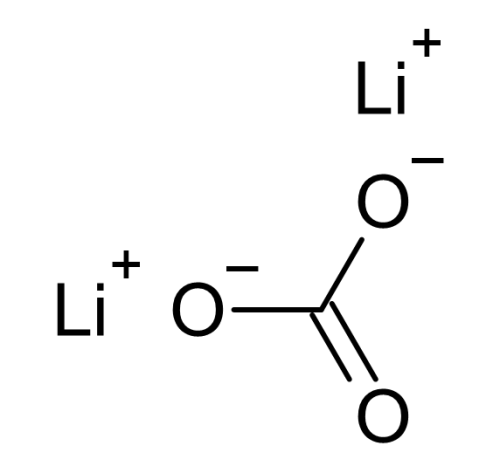
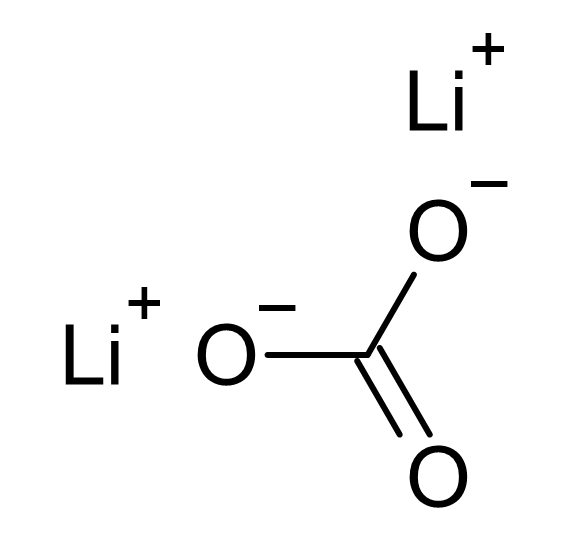
Lithium carbonate is an inorganic lithium salt composed of two lithium cations and one carbonate anion. It is one of the most important lithium compounds used as a precursor in inorganic synthesis, electrochemical materials and ceramic systems. At ambient pressure, crystalline Li2CO3 has a monoclinic structure with space group C2/c. Structural studies show that the lattice contains planar carbonate ions associated with lithium atoms coordinated by oxygen atoms.
Chemical and physical properties
Lithium carbonate is a high-melting ionic solid. Reference data report a melting point of approximately 723 °C and a density of approximately 2.11 g/cm3. At substantially higher temperatures it undergoes thermal decomposition rather than conventional boiling, with decomposition reported at approximately 1310 °C.
Unlike many alkali-metal salts, lithium carbonate is only moderately soluble in water. Its aqueous solubility exhibits an unusual inverse temperature dependence: experimental measurements show that solubility decreases as temperature increases. This behavior is technologically important because elevated-temperature precipitation can be used during crystallization and purification of lithium carbonate. The solubility is additionally affected by the presence and concentration of other dissolved salts.
Aqueous lithium carbonate suspensions and solutions exhibit mildly alkaline behavior as a consequence of carbonate hydrolysis. In acidic media, carbonate is protonated and lithium carbonate reacts with acids to form corresponding lithium salts while carbon dioxide is released. These acid-base properties make Li2CO3 useful as a lithium source in numerous inorganic and solid-state reactions.
The morphology and particle-size distribution of lithium carbonate crystals depend strongly on crystallization conditions. Experimental investigations have shown that additives, including polyelectrolytes and surfactants, can modify crystal habit from conventional particles to spherulitic or needle-like structures. Control of particle morphology is particularly important when Li2CO3 is subsequently used as a reactive precursor.
Applications
Lithium carbonate is extensively used as a lithium precursor in the synthesis of electrode materials for lithium-ion batteries. It reacts with transition-metal-containing precursors during high-temperature processing to form layered lithium transition-metal oxides. Scientific studies describe its use in the preparation of materials such as LiNi0.6Co0.2Mn0.2O2 and related nickel-manganese-cobalt cathode compositions.
Li2CO3 is also used as a precursor for lithium titanate materials. Solid-state reaction of lithium carbonate with TiO2 can produce spinel Li4Ti5O12, an electrode material investigated extensively for lithium-ion electrochemical systems. Particle size and morphology of the starting materials strongly influence phase formation and the properties of the resulting lithium titanate.
In ceramic and glass-ceramic research, lithium carbonate serves as a source of lithium oxide during high-temperature processing. It is used in the preparation of lithium aluminosilicate materials, including low-thermal-expansion glass-ceramic systems. During thermal treatment, carbonate-containing starting mixtures react to produce lithium-containing crystalline phases whose composition and microstructure determine the thermal and mechanical properties of the final material.
Lithium carbonate is additionally important in hydrometallurgical processing and recycling of lithium-ion batteries. Lithium recovered from spent electrode materials can be converted into Li2CO3 by precipitation and purification processes, after which the recovered compound may be reused as a precursor for new lithium-containing electrode materials.
In pharmaceutical science, lithium carbonate is a well-established source of lithium ions used in the treatment and long-term management of bipolar disorder. Its pharmacological effects involve several intracellular signaling mechanisms, including modulation of glycogen synthase kinase-3 and pathways associated with neuronal signaling and plasticity. Because lithium has a narrow therapeutic range, pharmaceutical use requires controlled dosing and therapeutic monitoring and should not be extrapolated to laboratory- or technical-grade material.
Handling and safety
Lithium carbonate should be handled in a manner that minimizes generation and inhalation of dust and prevents unnecessary skin or eye contact. Reference safety data classify the material as harmful if swallowed and capable of causing eye irritation. Laboratory handling should therefore include suitable eye protection, protective gloves and appropriate control of airborne particulate matter.
Scientific references
Du, L. et al. Molecular dynamics simulations of solvent effects on the crystal morphology of lithium carbonate. RSC Advances, 2020.
Du, H. et al. Solubility of Li2CO3 in Na–K–Li–Cl brines from 20 to 90 °C. Journal of Chemical Thermodynamics, 2014.
Zhang, Y.; Cao, H.; Zhang, J.; Xia, B. Synthesis of LiNi0.6Co0.2Mn0.2O2 cathode material by a carbonate co-precipitation method and its electrochemical characterization. Solid State Ionics, 2006, 177, 3303–3307. DOI: 10.1016/j.ssi.2006.09.008.
High-pressure structure of Li2CO3. Journal of Solid State Chemistry, 2003, 173, 13–19. DOI: 10.1016/S0022-4596(03)00053-7.
Airainer, M.; Seifert, R. Lithium, the gold standard drug for bipolar disorder: analysis of current clinical studies. Naunyn-Schmiedeberg's Archives of Pharmacology, 2024, 397, 9723–9743. DOI: 10.1007/s00210-024-03210-8.
Safety

Signal Word: Danger
GHS Hazard Statements:
H302: Harmful if swallowed
H315: Causes skin irritation
H318: Causes serious eye damage
H319: Causes serious eye irritation
H335: May cause respiratory irritation
H360: May damage fertility or the unborn child
H372: Causes damage to organs through prolonged or repeated exposure
Precautionary Statements:
P203, P260, P261, P264, P264+P265, P270, P271, P280,
P301+P317, P302+P352, P304+P340,
P305+P351+P338, P305+P354+P338, P317, P318, P319, P321,
P330, P332+P317, P337+P317, P362+P364, P403+P233, P405, P501
First Aid Measures
Eye Contact: Rinse cautiously with water for several minutes. Remove contact lenses if present and easy to do. Continue rinsing. Seek medical attention if irritation persists.
Skin Contact: Wash with plenty of soap and water. If skin irritation occurs, seek medical advice.
Inhalation: Move person to fresh air and keep comfortable for breathing. Seek medical attention if symptoms occur.
Ingestion: Rinse mouth. Do not induce vomiting. Seek medical attention if unwell.
Handling and Storage
Storage Conditions: Store in a tightly closed container in a dry, well-ventilated place.
Handling Precautions: Avoid contact with skin, eyes, and clothing. Use appropriate personal protective equipment.