
 CATEGORIES
- ORGANIC COMPOUNDS(1240)
- INORGANIC COMPOUNDS(1103)
- Mineral Acids(51)
- Chelates(3)
- Elements(136)
- Salts(593)
- Oxides(120)
- Hydroxides(36)
- Hydrides(15)
- Other(19)
- Nanoparticles(3)
- Standard solutions(126)
- LAB EQUIPMENT(5176)
- *(1)
- Organic Synthesis(438)
- Industry(783)
Language
US version allows shipping to all available destinations


 MANUFACTURER
Hydrobromic Acid 48%
Regular price:
Regular price:
product unavailable
add to wish list
0


Description
Hydrobromic Acid 48%
Other Names: Hydrogen bromide solution, Aqueous hydrogen bromide, Hydrobromic acid
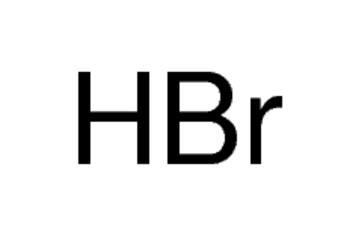
Chemical Formula: HBr
Concentration: 48 wt.% HBr in water
Molar Mass: 80.91 g/mol (HBr)
CAS Number: 10035-10-6
SMILES: Br
Appearance: Clear, colorless to pale yellow liquid
Odor: Pungent, irritating odor
Hydrobromic acid 48% is a concentrated aqueous solution of hydrogen bromide. Hydrogen bromide is a hydrogen halide composed of hydrogen and bromine and forms a strongly acidic solution when dissolved in water. In aqueous media, HBr behaves as a strong mineral acid, producing hydrated proton species and bromide ions. Modern thermodynamic studies classify hydrobromic acid among the strongest common hydrohalic acids in water, with its acidity strongly influenced by solvation and the leveling properties of aqueous media.
A concentration of 48 wt.% corresponds to approximately 48 g of HBr per 100 g of solution. Using a density of approximately 1.49 g/mL at 25 °C, the concentration corresponds to approximately 8.8 mol/L. Commercial 48% hydrobromic acid is therefore a highly concentrated source of both acidity and bromide ions and is widely used as a reagent in inorganic, organic and materials chemistry.
Chemical and physical properties
Hydrobromic acid 48% is a dense aqueous liquid. Published data for 48 wt.% HBr solutions report a density of approximately 1.49 g/mL at 25 °C. The molecular mass of hydrogen bromide is 80.91 g/mol.
The 48% solution is very close in composition to the constant-boiling hydrobromic acid–water mixture. The HBr–water system forms an azeotropic mixture containing approximately 47.6 wt.% HBr, which boils at about 124.3 °C at atmospheric pressure. Consequently, concentrated commercial hydrobromic acid near 48% exhibits physical behavior characteristic of this constant-boiling composition.
In water, hydrogen bromide undergoes extensive ionization to form bromide ions and solvated proton species. Its very high acidity has been examined using experimental thermodynamic data and high-level computational methods. Modern evaluations of strong-acid acidity demonstrate that numerical pKa values for acids such as HBr require careful treatment because very strong acids are subject to the leveling effect of water.
The bromide ion is a relatively strong nucleophile and a useful source of bromine in chemical transformations. In combination with the strongly acidic environment provided by concentrated HBr, this enables reactions involving protonation followed by nucleophilic substitution, addition and bromination.
Applications
Hydrobromic acid 48% is widely used as a reagent for converting alcohols into the corresponding alkyl bromides. Classical preparative studies demonstrate the use of aqueous 48% HBr for the synthesis of primary alkyl bromides, including ethyl, octyl and dodecyl bromides. In these reactions, protonation of the hydroxyl group facilitates substitution by bromide.
It is also used in transformations of oxygen-containing organic compounds. Scientific studies have demonstrated the use of 48% aqueous hydrobromic acid for reactions of diols, cyclic ethers and lactones, including the preparation of bromoalkanol derivatives.
Hydrobromic acid serves as a bromide source in oxidative bromination chemistry. In combination with suitable oxidants, HBr has been used for efficient bromination of olefins, alkynes and ketones, providing access to dibrominated alkanes, dibrominated alkenes and α-bromoketones.
In synthetic and materials chemistry, concentrated hydrobromic acid is also used to establish strongly acidic, bromide-rich reaction media. Scientific studies employ 48 wt.% HBr in the preparation and crystallization of bromide-containing inorganic and hybrid materials, where it can act simultaneously as an acidifying reagent and a source of bromide ions.
Scientific references
- ACS Committee on Analytical Reagents. Hydrobromic Acid, 48%. ACS Reagent Chemicals: Specifications and Procedures for Reagents and Standard-Grade Reference Materials. American Chemical Society, authoritative version 2025. DOI: 10.1021/acsreagents.4162.20251001.
- NIST Chemistry WebBook, SRD 69. Hydrogen Bromide, CAS 10035-10-6. National Institute of Standards and Technology. Molecular, thermodynamic and spectroscopic data.
- Trummal, A.; Lipping, L.; Kaljurand, I.; Koppel, I. A.; Leito, I. Acidity of Strong Acids in Water and Dimethyl Sulfoxide. Journal of Physical Chemistry A, 2016, 120, 3663–3669. DOI: 10.1021/acs.jpca.6b02253.
- Kamm, O.; Marvel, C. S. Alkyl and Alkylene Bromides – Hydrobromic Acid Method. Organic Syntheses, 1921; Collective Volume 1, 1941. DOI: 10.15227/orgsyn.001.0003.
- Kad, G. L.; Kaur, I.; Bhandari, M.; Singh, J.; Kaur, J. Functional Group Transformations of Diols, Cyclic Ethers, and Lactones Using Aqueous Hydrobromic Acid and Phase Transfer Catalyst under Microwave Irradiation. Organic Process Research & Development, 2003, 7, 339–340. DOI: 10.1021/op025606h.
- Song, S.; Li, X.; Sun, X.; Yuan, Y.; Jiao, N. Efficient Bromination of Olefins, Alkynes, and Ketones with Dimethyl Sulfoxide and Hydrobromic Acid. Green Chemistry, 2015, 17, 3285–3289. DOI: 10.1039/C5GC00528K.
- PubChem. Hydrogen Bromide, CID 260. National Center for Biotechnology Information. Molecular identifiers, formula and structural information.
Safety


Signal Word: Danger
H280 (32.9%): Contains gas under pressure; may explode if heated [Warning Gases under pressure]
H314 (99.8%): Causes severe skin burns and eye damage [Danger Skin corrosion/irritation]
H318 (40%): Causes serious eye damage [Danger Serious eye damage/eye irritation]
H331 (17.8%): Toxic if inhaled [Danger Acute toxicity, inhalation]
H335 (99.3%): May cause respiratory irritation [Warning Specific target organ toxicity, single exposure; Respiratory tract irritation]
P260, P261, P264, P264+P265, P271, P280, P301+P330+P331, P302+P361+P354, P304+P340, P305+P354+P338, P316, P317, P319, P321, P363, P403+P233, P405, P410+P403, and P501
Handling and Storage
Storage Conditions: Store in a tightly closed, corrosion-resistant container in a cool, dry, well-ventilated area. Keep away from incompatible materials such as strong oxidizers and bases.
Handling Precautions: Use only under a chemical fume hood. Avoid contact with skin, eyes, and clothing. Handle with full PPE including acid-resistant gloves and eye/face protection.