
 CATEGORIES
- ORGANIC COMPOUNDS(1135)
- INORGANIC COMPOUNDS(1055)
- Mineral Acids(51)
- Chelates(3)
- Elements(130)
- Salts(556)
- Aluminium(18)
- Ammonium(51)
- Antimony(4)
- Barium(20)
- Bismuth(5)
- Caesium(9)
- Cadmium(2)
- Calcium(33)
- Cesium(3)
- Copper(22)
- Cobalt(13)
- Chromium(11)
- Lead(14)
- Lanthanum(12)
- Lithium(15)
- Manganese(12)
- Sodium(151)
- Silver(7)
- Potassium(54)
- Zinc(16)
- Cerium(2)
- Tin(5)
- Nickel(11)
- Gold(0)
- Iron(22)
- Zirconium(1)
- Mercury(2)
- Magnesium(21)
- Strontium(17)
- Mixed Salts(1)
- Oxides(121)
- Hydroxides(30)
- Hydrides(15)
- Other(19)
- Nanoparticles(3)
- Standard solutions(126)
- LAB EQUIPMENT(5176)
- *(1)
- Organic Synthesis(421)
- Industry(775)
Language
US version allows shipping to all available destinations


 MANUFACTURER
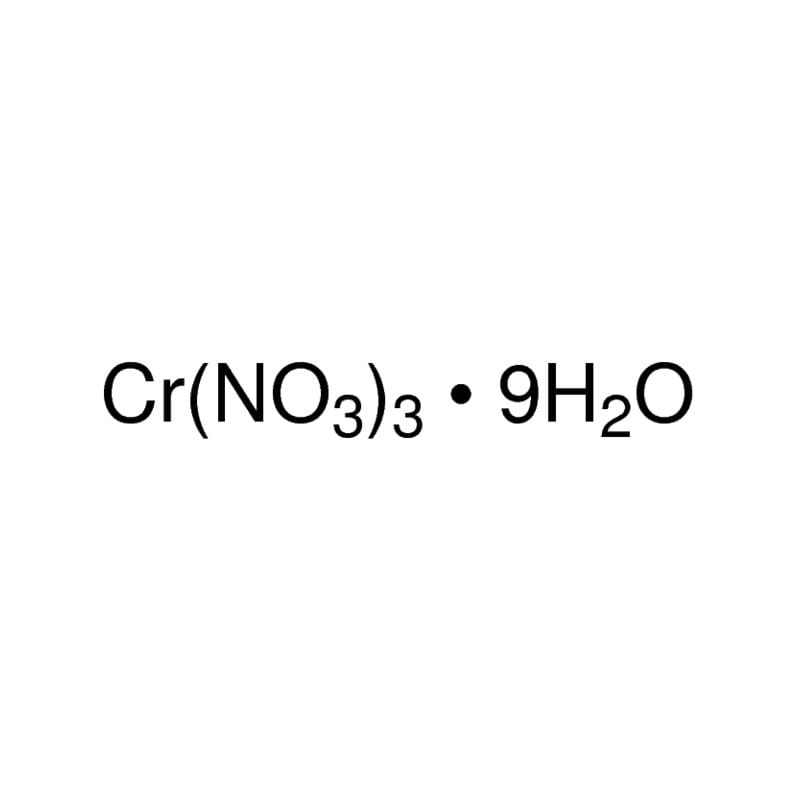
Chromium (III) nitrate nonahydrate
Regular price:
Regular price:
product unavailable
add to wish list
0

 nitrate nonahydrate "Pin It")
Description
Chromium(III) Nitrate Nonahydrate
Other Names: Chromium nitrate nonahydrate, Chromic nitrate nonahydrate
CAS Number: 7789-02-8
Sum Formula: Cr(NO₃)₃·9H₂O
Molar Mass: 400.15 g/mol
Appearance: Dark purple to violet crystalline solid
Chromium(III) nitrate nonahydrate is an inorganic salt of trivalent chromium and nitric acid, commonly encountered as a hydrated crystalline compound. It is primarily used in laboratories and industry for synthesis, dyeing, and as a catalyst precursor.
Chemical and Physical Properties
Density: 1.85 g/cm³
Melting Point: 60°C (decomposes on further heating)
Boiling Point: Not applicable (decomposes)
Solubility in Water: Soluble
Solubility in Other Solvents: Slightly soluble in alcohol; insoluble in nonpolar solvents
Odor: Odorless
Applications
Inorganic Synthesis: Used to produce other chromium(III) compounds.
Catalysis: Precursor to chromium-based catalysts.
Textile and Leather Industry: Sometimes applied in dyeing or tanning processes.
Analytical Chemistry: Reagent in qualitative and quantitative analysis involving chromium species.
Safety

Signal Word: Warning
H272 (93.2%): May intensify fire; oxidizer [Danger Oxidizing liquids; Oxidizing solids]
H302 (15.7%): Harmful if swallowed [Warning Acute toxicity, oral]
H315 (42.9%): Causes skin irritation [Warning Skin corrosion/irritation]
H317 (55%): May cause an allergic skin reaction [Warning Sensitization, Skin]
H319 (45%): Causes serious eye irritation [Warning Serious eye damage/eye irritation]
H332 (57.1%): Harmful if inhaled [Warning Acute toxicity, inhalation]
H411 (55%): Toxic to aquatic life with long lasting effects [Hazardous to the aquatic environment, long-term hazard]
P210, P220, P261, P264, P264+P265, P270, P271, P272, P273, P280, P301+P317, P302+P352, P304+P340, P305+P351+P338, P317, P321, P330, P332+P317, P333+P317, P337+P317, P362+P364, P370+P378, P391, and P501
Handling and Storage
Storage Conditions: Store in a tightly closed container in a cool, dry, and well-ventilated area. Protect from heat, moisture, and incompatible substances such as strong oxidizing or reducing agents.
Handling Precautions: Avoid generating dust and contact with skin or eyes. Use appropriate protective equipment and good laboratory practices.