
 CATEGORIES
- ORGANIC COMPOUNDS(1140)
- INORGANIC COMPOUNDS(1055)
- Mineral Acids(51)
- Chelates(3)
- Elements(130)
- Salts(556)
- Oxides(121)
- Hydroxides(30)
- Hydrides(15)
- Other(19)
- Nanoparticles(3)
- Standard solutions(126)
- LAB EQUIPMENT(5176)
- *(1)
- Organic Synthesis(421)
- Industry(775)
Language
US version allows shipping to all available destinations


 MANUFACTURER
Antimony Metal Sb >99.5%
Regular price:
Regular price:
product unavailable
add to wish list
0


Description
Antimony
Other Names: Stibium, Metallic antimony, Antimony metal
Chemical Formula: Sb
Atomic Number: 51
Molar Mass: 121.760 g/mol
CAS Number: 7440-36-0
SMILES: [Sb]
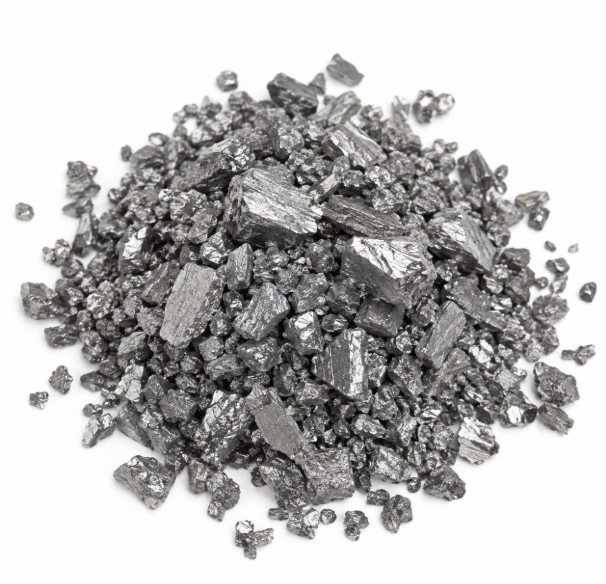
Appearance: Silvery-white to gray, lustrous and brittle solid
Odor: Odorless
Antimony is a group 15 chemical element with the symbol Sb, derived from the Latin name stibium. In its common metallic allotrope it is a hard, brittle, silvery material generally classified as a metalloid or semimetal. Elemental antimony combines metallic appearance with relatively poor electrical and thermal conductivity compared with typical metals. Its electronic configuration is [Kr] 4d105s25p3, and the most important oxidation states in antimony chemistry are +3 and +5, while −3 occurs in antimonide compounds. Antimony is important in metallurgy and materials science because relatively small additions can significantly modify the mechanical and physical properties of other metals.
Chemical and physical properties
Antimony is a solid at room temperature and has a density of approximately 6.68–6.69 g/cm3. It melts at approximately 630.63 °C and has a normal boiling point of approximately 1587 °C.
The stable crystalline form of elemental antimony has a rhombohedral structure related to the A7 structure characteristic of several group 15 elements. Its layered atomic arrangement contributes to strongly anisotropic electronic and physical properties. The material is brittle and can be readily fractured or pulverized compared with ductile metallic elements.
Elemental antimony is practically insoluble in water. Under oxidizing conditions, however, its surface can react to form antimony oxides. Antimony readily forms compounds with halogens, sulfur and other non-metallic elements, and its +3 and +5 oxidation states give rise to a broad range of inorganic compounds.
High-purity antimony is particularly important where controlled electrical properties are required. Purification methods investigated for elemental antimony include vacuum distillation and zone refining, which can reduce metallic and metalloid impurities to levels suitable for electronic and advanced-material applications.
Applications
Antimony is widely used as an alloying element. Addition of antimony to lead significantly increases hardness, tensile strength and creep resistance compared with pure lead. Lead–antimony alloys are therefore used in applications requiring mechanically stronger lead-based components, including selected grid, terminal and structural components in lead-acid electrochemical systems.
High-purity antimony is used in semiconductor and electronic-material production. Elemental antimony can serve as a source material for antimonide semiconductors such as indium antimonide (InSb) and gallium antimonide (GaSb). These materials are investigated and used in infrared detection, high-frequency electronics, optoelectronics and other devices where narrow-band-gap semiconductor properties are required.
Antimony is also used as an n-type dopant in semiconductor materials such as silicon and germanium. Controlled incorporation of small quantities of antimony introduces donor states and allows adjustment of electrical conductivity, making high-purity antimony relevant to semiconductor crystal growth and electronic materials research.
Elemental antimony is an important precursor for the manufacture of antimony compounds, particularly antimony(III) oxide. Antimony oxide materials are extensively studied in polymer and materials science, including their use in flame-retardant systems in combination with suitable halogen-containing compounds.
In materials research, antimony and antimony-containing compounds are investigated for electronic, thermoelectric, photovoltaic and energy-storage materials. The distinctive electronic structure of Sb-containing compounds makes antimony an important component of numerous functional inorganic materials.
Scientific references
- PubChem. Antimony, CID 5354495. National Center for Biotechnology Information. Molecular and elemental identifiers, atomic mass, CAS number and SMILES.
- NIST Physical Measurement Laboratory. Composition of Antimony. National Institute of Standards and Technology. Reference density data for elemental antimony.
- Royal Society of Chemistry. Antimony – Element 51. Periodic Table. Atomic properties, density, melting point, boiling point and electronic configuration.
- Li Z., Feng Y., Wen Y., Wang R., Peng X. “Preparation technology research progress of high-purity antimony.” Transactions of Nonferrous Metals Society of China, 2025, 35(2), 579–601. DOI: 10.1016/S1003-6326(24)66701-4.
- Bennett B. R., Magno R., Boos J. B., Kruppa W., Ancona M. G. “Antimonide-based compound semiconductors for electronic devices: A review.” Solid-State Electronics, 2005, 49(12), 1875–1895. DOI: 10.1016/j.sse.2005.09.008.
- Prengaman R. D. “Secondary Batteries – Lead–Acid Systems: Lead Alloys.” Encyclopedia of Electrochemical Power Sources, Elsevier, 2009. Scientific discussion of the structure and mechanical properties of lead–antimony alloys.
- Zhang Y. et al. “Advances and challenges in improvement of the electrochemical performance for lead-acid batteries: A comprehensive review.” Journal of Power Sources, 2022. Review of lead–antimony alloy properties and their influence on electrochemical systems.
