
 CATEGORIES
- ORGANIC COMPOUNDS(1140)
- INORGANIC COMPOUNDS(1055)
- Mineral Acids(51)
- Chelates(3)
- Elements(130)
- Salts(556)
- Oxides(121)
- Hydroxides(30)
- Hydrides(15)
- Other(19)
- Nanoparticles(3)
- Standard solutions(126)
- LAB EQUIPMENT(5176)
- *(1)
- Organic Synthesis(421)
- Industry(775)
Language
US version allows shipping to all available destinations


 MANUFACTURER
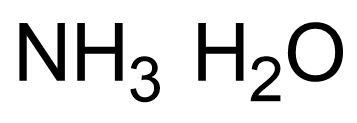
Ammonia Solution Aq. 25%
Regular price:
Regular price:
product unavailable
add to wish list
0


Description
Ammonia Solution 25%
Other Names: Aqueous ammonia, Ammonia water, Aqua ammonia, Ammonium hydroxide solution
Chemical Formula: NH3(aq)
Concentration: 25% w/w NH3 in water
Molar Mass (NH3): 17.03 g/mol
CAS Number: 1336-21-6
SMILES: N.O
Appearance: Clear, colorless liquid
Odor: Strong, characteristic pungent ammonia odor
Ammonia Solution 25% is a concentrated aqueous solution containing approximately 25% by mass ammonia (NH3). Although aqueous ammonia is frequently referred to as ammonium hydroxide, the solution is more accurately described as a dynamic equilibrium system containing dissolved molecular ammonia, ammonium ions, hydroxide ions and water. Ammonia acts as a weak Brønsted base and reacts reversibly with water according to the equilibrium NH3 + H2O ⇌ NH4+ + OH−. The ammonium ion has a pKa of approximately 9.25 at 25 °C, giving concentrated ammonia solutions strongly alkaline properties. Ammonia is also an important coordination ligand and can form stable ammine complexes with numerous transition-metal ions, making aqueous ammonia useful in inorganic, analytical and coordination chemistry.
Chemical and physical properties
Ammonia Solution 25% is a colorless, highly volatile alkaline liquid. Experimental and reference data for solutions of this concentration report a density of approximately 0.90–0.91 g/cm3 near room temperature.
A 25% aqueous ammonia solution has a boiling point of approximately 38 °C under atmospheric pressure and a freezing point close to −58 °C. These values differ substantially from those of pure water because the ammonia–water system exhibits strong composition-dependent vapor–liquid equilibrium behavior.
The vapor pressure of a 25% solution is approximately 48 kPa at 20 °C. Ammonia preferentially enters the vapor phase, so the composition of an exposed solution can change through ammonia evaporation. Experimental vapor–liquid equilibrium studies have demonstrated strongly non-ideal behavior of ammonia–water mixtures over broad ranges of temperature, pressure and composition.
Ammonia is completely miscible with water at the concentrations relevant to commercial aqueous solutions. Its basic properties originate from proton transfer between dissolved NH3 and water. In addition to acid–base chemistry, the nitrogen lone pair allows ammonia to coordinate metal ions, producing characteristic metal–ammine complexes. This behavior is particularly important in copper, nickel, zinc and other transition-metal systems.
Applications
Ammonia Solution 25% is widely used as an alkaline laboratory and industrial reagent. It is employed for pH adjustment, neutralization of acidic reaction mixtures and generation of controlled alkaline conditions in chemical synthesis and analytical procedures.
In inorganic and analytical chemistry, aqueous ammonia is used in selective precipitation and complexation reactions. Hydroxide ions generated in solution can promote precipitation of metal hydroxides, while ammonia itself can coordinate dissolved metal ions and modify their solubility, speciation and reaction behavior.
High-purity aqueous ammonia is an important process chemical in semiconductor and microelectronics manufacturing. It is a component of the RCA Standard Clean 1 process, where ammonium hydroxide, hydrogen peroxide and ultrapure water are combined to remove particles and contaminants from silicon wafer surfaces. Research on semiconductor processing has therefore placed particular emphasis on controlling trace metallic impurities in high-purity ammonium hydroxide solutions.
Aqueous ammonia is also used as a research medium in studies of solution thermodynamics, vapor–liquid equilibria, molecular solvation and coordination chemistry. Ammonia–water mixtures have been extensively investigated because their thermodynamic properties depend strongly on concentration, temperature and pressure.
Scientific references
- PubChem. Ammonium Hydroxide, CID 14923. National Center for Biotechnology Information. Physical properties, composition, identifiers and aqueous ammonia data.
- Smolen T. M., Manley D. B., Poling B. E. “Vapor-liquid equilibrium data for the ammonia-water system and its description with a modified cubic equation of state.” Journal of Chemical & Engineering Data, 1991, 36(2), 202–208. DOI: 10.1021/je00002a017.
- Rizvi S. S. H., Heidemann R. A. “Vapor-liquid equilibria in the ammonia-water system.” Journal of Chemical & Engineering Data, 1987, 32(2), 183–191. DOI: 10.1021/je00048a017.
- Greenlee L. F., Renner J. N., Foster S. L. “The Use of Controls for Consistent and Accurate Measurements of Electrocatalytic Ammonia Synthesis from Dinitrogen.” ACS Catalysis, 2018, 8(9), 7820–7827. DOI: 10.1021/acscatal.8b02120.
- Manjusha R., Shekhar R., Jaikumar S. “Direct determination of impurities in high purity chemicals by electrolyte cathode discharge atomic emission spectrometry (ELCAD-AES).” Microchemical Journal, 2019, 145, 301–307. DOI: 10.1016/j.microc.2018.10.052.
- Mace E. J., Vrabec J. “Thermodynamic properties of ammonia-water mixtures in the vapor-liquid, critical, and Widom regions.” The Journal of Chemical Physics, 2025, 163, 184305. DOI: 10.1063/5.0293089.
Safety

Signal Word: Danger
H314 (99.9%): Causes severe skin burns and eye damage [Danger Skin corrosion/irritation]
H318 (10.9%): Causes serious eye damage [Danger Serious eye damage/eye irritation]
H335 (16.7%): May cause respiratory irritation [Warning Specific target organ toxicity, single exposure; Respiratory tract irritation]
H400 (99.8%): Very toxic to aquatic life [Warning Hazardous to the aquatic environment, acute hazard]
P260, P261, P264, P264+P265, P271, P273, P280, P301+P330+P331, P302+P361+P354, P304+P340, P305+P354+P338, P316, P317, P319, P321, P363, P391, P403+P233, P405, and P501
Handling and Storage
-
Storage Conditions: Store in tightly closed containers in a cool, well-ventilated area. Keep away from acids and incompatible materials.
-
Handling Precautions: Avoid inhalation of vapors. Use with adequate ventilation and wear suitable protective equipment. Prevent contact with skin and eyes.