
 CATEGORIES
- ORGANIC COMPOUNDS(1252)
- INORGANIC COMPOUNDS(1108)
- Mineral Acids(51)
- Chelates(3)
- Elements(138)
- Salts(596)
- Oxides(120)
- Hydroxides(36)
- Hydrides(15)
- Other(19)
- Nanoparticles(3)
- Standard solutions(126)
- LAB EQUIPMENT(5176)
- *(1)
- Organic Synthesis(450)
- Industry(783)
Language
US version allows shipping to all available destinations


 MANUFACTURER
Sodium Metal
Regular price:
Regular price:
product unavailable
add to wish list
3.6


Description
Sodium Metal
Other Names: Sodium, Metallic Sodium, Natrium
Chemical Formula: Na
Molar Mass: 22.99 g/mol
CAS Number: 7440-23-5
Atomic Number: 11
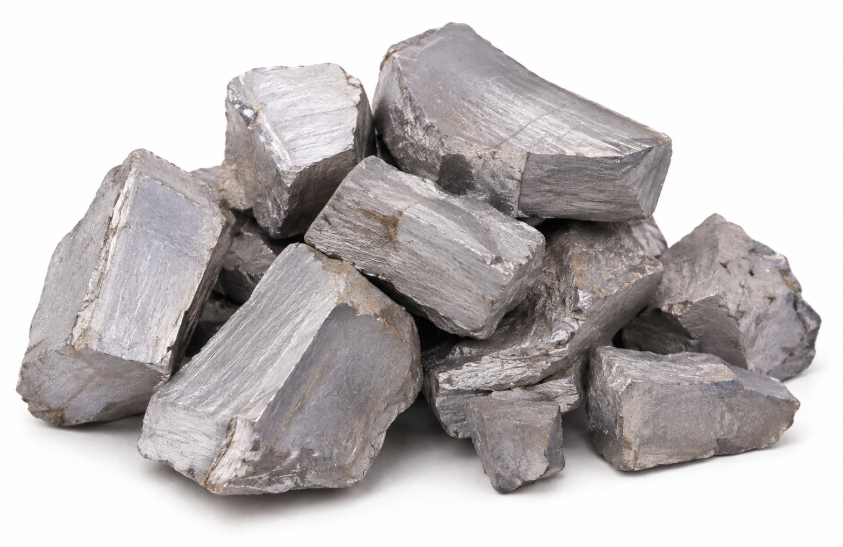
Appearance: Soft, silvery-white metallic solid with a freshly cut reflective surface
Odor: Odorless
Density: Approximately 0.968 g/cm3 at 20 °C
Crystal Structure: Body-centered cubic (bcc) at ambient conditions
SMILES: [Na]
Sodium is a highly reactive alkali metal belonging to Group 1 of the periodic table. Its electronic configuration is [Ne]3s1, with a single valence electron that is readily removed to form the Na+ ion. This electronic structure accounts for the strongly electropositive and reducing character of elemental sodium and distinguishes the reactive metallic element from the much more chemically stable sodium ions present in its compounds.
Metallic sodium is soft and can be mechanically deformed at room temperature. Its freshly exposed surface has a bright metallic appearance, but the surface rapidly becomes coated with reaction products when exposed to atmospheric oxygen and moisture. Sodium is an excellent electrical and thermal conductor and has an unusually low melting point compared with many common structural metals.
Chemical and physical properties
Sodium is a solid at room temperature and crystallizes in a body-centered cubic structure under ambient conditions. X-ray diffraction measurements of metallic sodium have determined a room-temperature lattice constant of approximately 4.29 Å. Detailed crystallographic studies show that its structure can undergo transformations at low temperatures and at very high pressures.
The melting point of sodium is approximately 370.96 K, corresponding to 97.81 °C. The NIST Chemistry WebBook reports a normal boiling point of approximately 1156 K, or about 883 °C. Its relatively low melting temperature allows sodium to be used as a liquid metal over a broad temperature range.
The density of solid sodium is approximately 0.968 g/cm3 at 20 °C, making it less dense than water. Its thermal conductivity is approximately 130–140 W·m−1·K−1 near room temperature, reflecting the high mobility of conduction electrons characteristic of metallic bonding.
Sodium has a low first ionization energy and readily transfers its outer electron to other chemical species. It therefore functions as a strong reducing agent in numerous inorganic and organic transformations. The dominant oxidation state in ordinary sodium compounds is +1.
Metallic sodium reacts strongly with water according to the overall reaction 2Na + 2H2O → 2NaOH + H2. The process is strongly exothermic and produces hydrogen together with sodium hydroxide. Sodium also reacts readily with oxygen, halogens, alcohols and numerous other protic or oxidizing substances.
Because of its high chemical reactivity toward oxygen and water, elemental sodium is not encountered naturally as a free metal under ordinary terrestrial conditions. Instead, sodium occurs predominantly in the form of thermodynamically stable ionic compounds.
Applications
Sodium metal is widely used as a reducing reagent in synthetic chemistry. Its strong electron-donating properties make it useful in reactions involving reduction of organic and inorganic compounds, reductive coupling processes and the preparation of reactive intermediates.
In organic synthesis, sodium can be used in dissolving-metal reductions and in reactions that involve single-electron transfer. Metallic sodium has historically played an important role in carbon–carbon bond-forming reactions, including Wurtz-type coupling chemistry, and in the preparation of sodium alkoxides and related organometallic or strongly basic reagents.
Sodium is used as a precursor in the production of numerous sodium-containing chemicals where direct reaction of the metal provides access to highly reactive sodium derivatives. Examples include sodium alkoxides and selected organosodium compounds used as reagents or intermediates in laboratory and industrial synthesis.
Liquid sodium has important heat-transfer applications because of its high thermal conductivity, relatively low viscosity and wide liquid temperature range. It has been extensively investigated and employed as a coolant in sodium-cooled fast nuclear reactor systems, where efficient heat removal from high-power-density reactor cores is required.
Metallic sodium has also been used in specialized heat-transfer devices, high-temperature systems and sodium vapor technologies. Atomic sodium produces intense characteristic emission lines, particularly the well-known yellow D-lines near 589 nm, making sodium vapor important in spectroscopic research and historically in discharge lighting technologies.
In fundamental research, sodium serves as a model nearly-free-electron metal. Its comparatively simple electronic structure has made it important in studies of metallic bonding, Fermi surfaces, lattice dynamics, phase transitions, high-pressure physics and condensed-matter theory.
Scientific references
- National Institute of Standards and Technology. NIST Chemistry WebBook, SRD 69: Sodium, CAS 7440-23-5. Phase-change, thermochemical and atomic data.
- Rodebush, W. H.; Walters, E. G. “The Vapor Pressure and Vapor Density of Sodium.” Journal of the American Chemical Society, 1930, 52, 2654–2665. DOI: 10.1021/ja01370a011.
- Abe, H.; Ohshima, K.; Suzuki, T.; Watanabe, Y. “Temperature Dependence of the Lattice Constant in Metallic Sodium.” Journal of Applied Crystallography, 1994, 27, 1040–1042. DOI: 10.1107/S0021889894008642.
- Abe, H.; Ohshima, K.; Suzuki, T.; Hoshino, S.; Kakurai, K. “Neutron-Scattering Study of Metallic Sodium.” Physical Review B, 1994, 49, 3739–3745.
- Gregoryanz, E.; Lundegaard, L. F.; McMahon, M. I.; Guillaume, C.; Nelmes, R. J.; Mezouar, M. “Structural Diversity of Sodium.” Science, 2008, 320, 1054–1057.
- Lundegaard, L. F.; Gregoryanz, E.; McMahon, M. I.; Guillaume, C.; Loa, I.; Nelmes, R. J. “Single-Crystal Studies of Incommensurate Na to 1.5 Mbar.” Physical Review B, 2009, 79, 064105.
- Sakamoto, Y.; Garnier, J.-C.; Rouault, J.; Grandy, C.; Fanning, T.; Hill, R.; Chikazawa, Y.; Kotake, S. “Selection of Sodium Coolant for Fast Reactors in the US, France and Japan.” Nuclear Engineering and Design, 2013, 254, 194–217. DOI: 10.1016/j.nucengdes.2012.09.009.
- Müller, R. A.; Smidt, D. “Liquid Metal Cooled Fast Breeder Reactor Development and Its Mechanical-Structural Requirements and Problems.” Nuclear Engineering and Design, 1972, 19, 85–98. DOI: 10.1016/0029-5493(72)90011-8.
CLP Classification:
H Statements (Hazards):
- H260: In contact with water, releases flammable gases which may ignite spontaneously.
- H314: Causes severe skin burns and eye damage.
- H335: May cause respiratory irritation.
P Statements (Precautions):
- P223: Keep away from any contact with water.
- P280: Wear protective gloves/protective clothing/eye protection/face protection.
- P301+P330+P331: IF SWALLOWED: Rinse mouth. DO NOT induce vomiting.
- P303+P361+P353: IF ON SKIN (or hair): Remove immediately all contaminated clothing. Rinse skin with water/shower.
- P305+P351+P338: IF IN EYES: Rinse cautiously with water for several minutes. Remove contact lenses if present and easy to do. Continue rinsing.
- P370+P378: In case of fire: Use dry sand, dry chemical, or alcohol-resistant foam for extinction.
- P501: Dispose of contents/container in accordance with local regulations.
GHS Pictograms:
- GHS02: Flammable
- GHS05: Corrosive
- GHS07: Harmful