
 CATEGORIES
- ORGANIC COMPOUNDS(1135)
- INORGANIC COMPOUNDS(1055)
- Mineral Acids(51)
- Chelates(3)
- Elements(130)
- Salts(556)
- Aluminium(18)
- Ammonium(51)
- Antimony(4)
- Barium(20)
- Bismuth(5)
- Caesium(9)
- Cadmium(2)
- Calcium(33)
- Cesium(3)
- Copper(22)
- Cobalt(13)
- Chromium(11)
- Lead(14)
- Lanthanum(12)
- Lithium(15)
- Manganese(12)
- Sodium(151)
- Silver(7)
- Potassium(54)
- Zinc(16)
- Cerium(2)
- Tin(5)
- Nickel(11)
- Gold(0)
- Iron(22)
- Zirconium(1)
- Mercury(2)
- Magnesium(21)
- Strontium(17)
- Mixed Salts(1)
- Oxides(121)
- Hydroxides(30)
- Hydrides(15)
- Other(19)
- Nanoparticles(3)
- Standard solutions(126)
- LAB EQUIPMENT(5176)
- *(1)
- Organic Synthesis(421)
- Industry(775)
Language
US version allows shipping to all available destinations


 MANUFACTURER
Nickel (II) Acetate Tetrahydrate
Regular price:
Regular price:
product unavailable
add to wish list
0

 Acetate Tetrahydrate "Pin It")
Description
Nickel Acetate Tetrahydrate
Other Names: Nickel(II) acetate tetrahydrate, Nickel diacetate tetrahydrate, Acetic acid nickel(II) salt tetrahydrate
Chemical Formula: Ni(CH3COO)2·4H2O; C4H14NiO8
Molar Mass: 248.84 g/mol
CAS Number: 6018-89-9
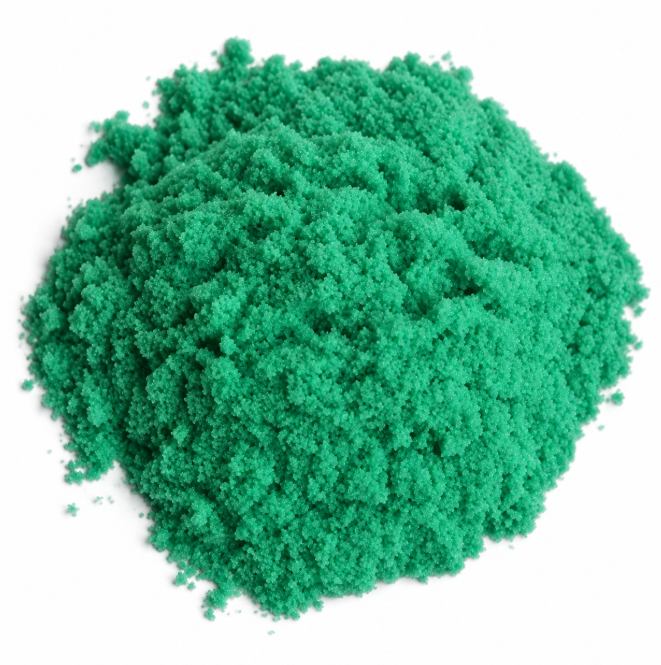
Appearance: Green crystalline solid
Crystal System: Monoclinic
SMILES: CC(=O)[O-].CC(=O)[O-].O.O.O.O.[Ni+2]
Nickel acetate tetrahydrate is a hydrated nickel(II) salt of acetic acid containing one Ni2+ ion, two acetate anions and four molecules of water per formula unit. Single-crystal X-ray diffraction studies show that the compound crystallizes in the monoclinic system with space group P21/c. The crystal structure is stabilized by an extended network of hydrogen-bonding interactions involving coordinated or lattice water molecules and acetate groups. Nickel acetate tetrahydrate is widely used in inorganic, coordination and materials chemistry as a soluble source of Ni2+ ions and as a precursor for the preparation of nickel-containing materials. Its ability to undergo controlled dehydration and thermal decomposition makes it particularly useful in solution-based and thermal synthesis methods.
Chemical and physical properties
Nickel acetate tetrahydrate is typically obtained as a green crystalline solid and is soluble in water. Its molecular mass is approximately 248.84 g/mol. Single-crystal diffraction measurements at approximately 298 K have reported a calculated crystal density of about 1.685 g/cm3.
Crystallographic investigations describe nickel acetate tetrahydrate as monoclinic, with the space group P21/c. Reported unit-cell parameters are approximately a = 0.48319 nm, b = 1.1900 nm and c = 0.85531 nm, with a unit-cell volume of approximately 0.49064 nm3. Hydrogen bonding between water molecules and acetate groups contributes to the formation of an extended three-dimensional structural network.
The compound undergoes characteristic thermal dehydration and decomposition when heated. Thermogravimetric, calorimetric and X-ray diffraction studies indicate that its decomposition in air proceeds through two major stages. Below approximately 240 °C, dehydration occurs together with hydrolysis processes and formation of basic nickel acetate species. At higher temperatures further decomposition takes place, ultimately producing nickel(II) oxide, NiO.
The presence of water molecules and acetate ligands gives nickel acetate tetrahydrate useful solution-processing characteristics. The Ni2+ center can participate in ligand-exchange and coordination reactions, allowing the compound to serve as a convenient starting material for the synthesis of nickel coordination compounds and inorganic nickel-containing phases.
Applications
Nickel acetate tetrahydrate is extensively used as a precursor for the preparation of nickel oxide materials. Sol-gel processing with nickel acetate tetrahydrate has been used to synthesize nanocrystalline NiO, with subsequent thermal treatment producing oxide particles whose structural and magnetic characteristics depend on processing and calcination conditions.
The compound is also used as a precursor for NiO thin films. Scientific studies have employed solutions of nickel acetate tetrahydrate in sol-gel dip-coating, spin-coating and related solution-deposition techniques to obtain polycrystalline nickel oxide layers. Such materials are investigated for electrochromic, optical, electronic and photovoltaic applications.
Thermal decomposition of nickel acetate tetrahydrate can also be used in the synthesis of metallic nickel nanoparticles. Controlled decomposition in organic reaction media has been demonstrated as a route to nickel nanoparticles with tunable particle size, morphology and crystalline phase.
In coordination chemistry, nickel acetate tetrahydrate is commonly employed as a source of Ni2+ for the preparation of nickel complexes with nitrogen-, oxygen- and other donor ligands. It is also used in research as a nickel precursor for mixed-metal oxides, layered materials and catalyst precursor systems.
Scientific references
- PubChem, National Center for Biotechnology Information. Nickel acetate tetrahydrate, CID 62601. Molecular formula, molecular mass, identifiers, SMILES and physicochemical data.
- Tai, X.-S. Preparation and Crystal Structure Nickel Acetate Tetrahydrate. Advanced Materials Research, 2011, 396-398, 1860-1863. DOI: 10.4028/www.scientific.net/AMR.396-398.1860.
- Hong, J.; Guo, G.; Zhang, K. Kinetics and mechanism of non-isothermal dehydration of nickel acetate tetrahydrate in air. Journal of Analytical and Applied Pyrolysis, 2006, 77(2), 111-115. DOI: 10.1016/j.jaap.2006.02.007.
- Thota, S.; Kumar, J. Sol-gel synthesis and anomalous magnetic behaviour of NiO nanoparticles. Journal of Physics and Chemistry of Solids, 2007, 68(10), 1951-1964. DOI: 10.1016/j.jpcs.2007.06.010.
- Sawaby, A.; Selim, M. S.; Marzouk, S. Y.; Mostafa, M. A.; Hosny, A. Structure, optical and electrochromic properties of NiO thin films. Physica B: Condensed Matter, 2010, 405(16), 3412-3420. DOI: 10.1016/j.physb.2010.05.015.
- Luo, X. et al. Preparation of hexagonal close-packed nickel nanoparticles via a thermal decomposition approach using nickel acetate tetrahydrate as a precursor. Journal of Alloys and Compounds, 2009, 476(1-2), 864-868. DOI: 10.1016/j.jallcom.2008.09.117.
