
 CATEGORIES
- ORGANIC COMPOUNDS(1135)
- INORGANIC COMPOUNDS(1055)
- Mineral Acids(51)
- Chelates(3)
- Elements(130)
- Salts(556)
- Aluminium(18)
- Ammonium(51)
- Antimony(4)
- Barium(20)
- Bismuth(5)
- Caesium(9)
- Cadmium(2)
- Calcium(33)
- Cesium(3)
- Copper(22)
- Cobalt(13)
- Chromium(11)
- Lead(14)
- Lanthanum(12)
- Lithium(15)
- Manganese(12)
- Sodium(151)
- Silver(7)
- Potassium(54)
- Zinc(16)
- Cerium(2)
- Tin(5)
- Nickel(11)
- Gold(0)
- Iron(22)
- Zirconium(1)
- Mercury(2)
- Magnesium(21)
- Strontium(17)
- Mixed Salts(1)
- Oxides(121)
- Hydroxides(30)
- Hydrides(15)
- Other(19)
- Nanoparticles(3)
- Standard solutions(126)
- LAB EQUIPMENT(5176)
- *(1)
- Organic Synthesis(421)
- Industry(775)
Language
US version allows shipping to all available destinations


 MANUFACTURER
Barium Chloride Dihydrate
Regular price:
Regular price:
product unavailable
add to wish list
0


Description
Barium Chloride Dihydrate
Other Names: Barium dichloride dihydrate, Barium chloride hydrate
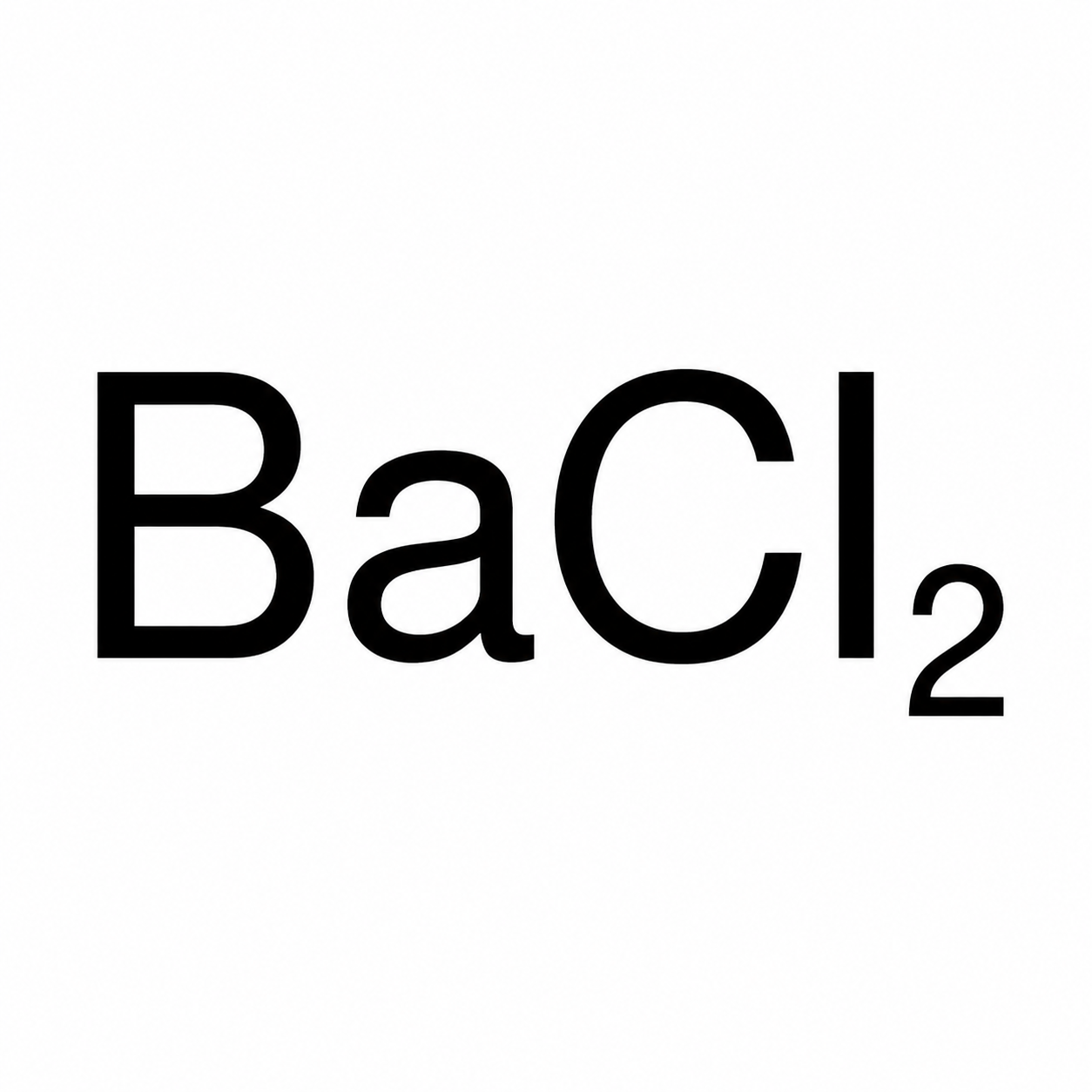
Chemical Formula: BaCl2·2H2O
Molar Mass: 244.26 g/mol
CAS Number: 10326-27-9
SMILES: O.O.[Cl-].[Cl-].[Ba+2]
Appearance: White crystalline solid or powder
Odor: Odorless
Barium chloride dihydrate is an inorganic barium salt containing one Ba2+ cation, two chloride anions and two molecules of water of crystallization per formula unit. It is the hydrated crystalline form commonly obtained from aqueous barium chloride solutions. The compound is highly soluble in water and readily provides barium ions in solution, making it a useful laboratory reagent for precipitation reactions, inorganic synthesis and analytical chemistry. Its crystalline structure and dehydration behavior have also been extensively investigated using diffraction and thermal-analysis techniques.
Chemical and physical properties
Barium chloride dihydrate is a white crystalline material with a molar mass of 244.26 g/mol. Experimental data report substantial solubility in water, with approximately 37.5 g dissolving in 100 mL of water at about 26 °C. Dissolution produces hydrated Ba2+ and Cl− ions.
The density of crystalline barium chloride dihydrate is approximately 3.1 g/cm3. Structural studies using neutron diffraction have established the arrangement of barium ions, chloride ions and coordinated water molecules in the hydrated crystal lattice. Crystallographic investigations describe the dihydrate as a well-defined ionic crystalline phase in which the water molecules form an integral part of the solid-state structure.
Heating barium chloride dihydrate causes removal of its water of crystallization. Thermal studies show that dehydration can proceed through formation of a monohydrate intermediate before conversion to anhydrous barium chloride. The kinetics and mechanism of this process depend strongly on temperature, water-vapor pressure, particle size and sample geometry.
In aqueous solution, barium ions react strongly with sulfate ions to form barium sulfate, BaSO4, an extremely sparingly soluble solid. This precipitation reaction is one of the most important chemical characteristics of soluble barium salts and forms the basis of numerous analytical and preparative procedures.
Applications
Barium chloride dihydrate is widely used as a source of Ba2+ ions in analytical chemistry. Its reaction with sulfate ions produces finely divided barium sulfate precipitate, allowing sulfate to be detected or quantitatively determined using gravimetric, turbidimetric and spectrophotometric techniques. Barium chloride-based sulfate determination has been extensively investigated for aqueous samples and analytical flow systems.
It is used as a precursor for the preparation of barium sulfate and other insoluble barium compounds. Controlled precipitation from solutions containing barium chloride enables preparation of BaSO4 particles with tailored particle size, morphology and surface characteristics for materials-science investigations.
Barium chloride dihydrate also serves as a soluble barium precursor in inorganic and coordination chemistry. It has been employed in hydrothermal and solution-phase syntheses of barium-containing coordination compounds, crystalline complexes and advanced inorganic materials where controlled introduction of Ba2+ ions is required.
The compound is additionally studied as a crystalline material in solid-state physics and materials chemistry. Pure and doped BaCl2·2H2O single crystals have been investigated by X-ray diffraction, vibrational spectroscopy and optical spectroscopy. Research has examined their crystallinity, optical response, photoluminescence and nonlinear optical properties.
Scientific references
- PubChem. Barium chloride, dihydrate, CID 5284346. National Center for Biotechnology Information. Molecular formula, molecular weight, CAS number, SMILES and physicochemical data.
- Padmanabhan, V. M.; Busing, W. R.; Levy, H. A. Barium chloride dihydrate by neutron diffraction. Acta Crystallographica Section B, 1978, 34, 2290–2292. DOI: 10.1107/S056774087800792X.
- Osterheld, R. K.; Bloom, P. R. Dehydration kinetics for barium chloride dihydrate single crystals. The Journal of Physical Chemistry, 1978, 82(14), 1591–1596. DOI: 10.102
SAFETY

Danger
Contains: Barium chloride (BaCl2), dihydrate, (EC: 600-412-6; CAS: 10326-27-9)
H301 Toxic if swallowed. H332 Harmful if inhaled.
P101 If medical advice is needed, have product container or label at hand. P102 Keep out of reach of children. P264 Wash hands and exposed parts of the body thoroughly after handling. P301+P310 IF SWALLOWED: Immediately call a doctor. P405 Store locked up. P501 Dispose of contents/container to by handing over to the person authorized to dispose of waste or by returning to the supplier.