
 CATEGORIES
- ORGANIC COMPOUNDS(1129)
- Thiols(1)
- Metal-organic compounds(1)
- Sulfonic acids(6)
- Alcohols(74)
- Aldehydes(47)
- Alkyl nitrites(6)
- Amines(55)
- Aminoacids(59)
- Amides(33)
- Anhydrides(11)
- Acyl Halides(5)
- Carboxylic Acids(170)
- Dyes and Indicators(99)
- Esters(52)
- Ethers(17)
- Organic Halogens (Organohalides)(30)
- Flavonoids(5)
- Heterocycles(24)
- Hydrocarbons(34)
- Imides(2)
- Ketones(29)
- Mixed solvents(16)
- Nitro Compounds(5)
- Nitriles(9)
- Organic salts(74)
- Phenols(30)
- Polymers ( HMW compounds )(68)
- Sugars (Saccharides)(24)
- Silicoorgano and Phosphoorganocompounds(1)
- Peptides(2)
- Terpenes(16)
- Others(126)
- INORGANIC COMPOUNDS(1055)
- LAB EQUIPMENT(5176)
- *(1)
- Organic Synthesis(417)
- Industry(775)
Language
US version allows shipping to all available destinations


 MANUFACTURER
Saturated hydrocarbons are compounds composed only of carbon and hydrogen in which carbon atoms are connected by single bonds. This group includes straight-chain or branched alkanes and cycloalkanes containing saturated rings. In organic synthesis, they are used mainly as solvents, hydrophobic media, feedstocks for C-H functionalization and model compounds for sigma-bond reactivity.
 Cyclohexane ( hexahydrobenzene ) Pure - 20 000ml
€326.16
Net price: €265.17
 Cyclohexane ( Hexahydroxybenzene, Hexamethylene, Hexanaphthen ) >99% - 1000ml
€37.28
Net price: €30.31
 Cyclohexane ( Hexahydroxybenzene, Hexamethylene, Hexanaphthen ) >99% - 100ml
€9.32
Net price: €7.58
 Cyclohexane ( Hexahydroxybenzene, Hexamethylene, Hexanaphthen ) >99% - 10ml
€4.57
Net price: €3.71
 Cyclohexane ( Hexahydroxybenzene, Hexamethylene, Hexanaphthen ) >99% - 5000ml
€139.78
Net price: €113.65
 Cyclohexane ( Hexahydroxybenzene, Hexamethylene, Hexanaphthen ) >99% - 500ml
€23.30
Net price: €18.94
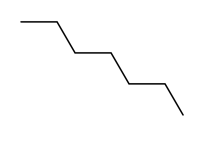 Heptane (N-Heptane)
€3.97
Net price: €3.23
 N- Hexane Hexan ( NOT Petroleum Fraction Pure N - Isomer ) - 1000ml
€23.30
Net price: €18.94
 N- Hexane Hexan ( NOT Petroleum Fraction Pure N - Isomer ) - 100ml
€4.19
Net price: €3.41
 N- Hexane Hexan ( NOT Petroleum Fraction Pure N - Isomer ) - 5000ml
€97.76
Net price: €79.48
 N- Hexane Hexan ( NOT Petroleum Fraction Pure N - Isomer ) - 500ml
€13.98
Net price: €11.36
 Hexane fraction from Naphtha
€2.57
Net price: €2.09
Alkanes and cycloalkanes as the main groups
Acyclic alkanes form homologous series with the general formula CnH2n+2, while cycloalkanes contain a ring and follow a different relationship between carbon and hydrogen count. Both groups are saturated because they do not contain C=C or C≡C bonds. Their structures may be linear, branched, monocyclic or polycyclic, which affects boiling point, viscosity, volatility and solubility.
Why are saturated hydrocarbons less reactive?
Saturated hydrocarbons mainly contain sigma C-C and C-H bonds. The absence of π bonds limits their ability to undergo classical addition reactions, while strong C-H bonds make direct functionalization difficult. For this reason, alkanes and cycloalkanes often require radical, catalytic, photochemical or high-temperature conditions to be converted into more reactive derivatives.
Use as solvents and non-polar media
Light and medium-chain alkanes such as pentane, hexane, heptane, isooctane or cyclohexane are often used as non-polar solvents. Their role comes from low polarity, ability to dissolve hydrophobic substances and relative inertness toward many reagents under mild conditions. They may be used in extraction, chromatography, crystallization, washing of solids and as components of organic phases.
C-H activation as a direction in synthetic research
C-H bond activation in alkanes is an important research area because it could convert simple and available feedstocks into more valuable products. The difficulty of this approach comes from the high energy required to cleave C-H bonds and from the problem of selectivity, especially when a molecule contains many similar reaction sites. Catalysts, reaction control and differences between primary, secondary and tertiary C-H bonds are therefore important.
Are saturated hydrocarbons completely inert?
Saturated hydrocarbons are not completely unreactive, but their typical reactivity is limited compared with alkenes, alkynes and arenes. They may undergo combustion, radical halogenation, cracking, isomerization, dehydrogenation and selected C-H activation reactions. Under laboratory conditions, however, they often behave as relatively inert media unless exposed to strong oxidants, radiation, high temperature or active catalysts.
Safety and limitations of use
Many saturated hydrocarbons are volatile and flammable, and some require particular control because of toxicity, narcotic effects, aspiration hazard or effects on the nervous system. Low-boiling alkanes can quickly form vapor-air mixtures, while longer-chain hydrocarbons may be less volatile but still flammable and hydrophobic. Use should always be based on the safety data sheet of the specific product.