



 chlorek dwuwodny ( miedzi chlorek ) "Pin It")
Copper(II) Chloride Dihydrate
Other Names: Cupric chloride
Copper(II) chloride dihydrate is the hydrated form of copper(II) chloride with two water molecules in its crystal lattice. Its formula is CuCl₂·2H₂O and its
CAS number 10125-13-0.
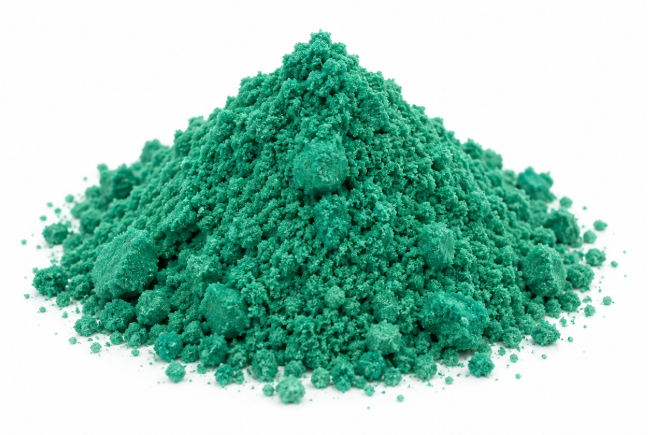
It appears as a blue-green to green crystalline solid, typically as needles or granules. The color comes from Cu²⁺ ions coordinated by both water molecules and chloride ions.
Key properties
-
Molar mass: ~170.48 g/mol.
-
Solubility: very soluble in water, producing blue-green solutions.
-
Magnetism: paramagnetic due to unpaired electrons on Cu²⁺.
-
Thermal behavior: on heating it dehydrates around ~100 °C, changing from green/blue-green to yellow-brown anhydrous CuCl₂; stronger heating may cause decomposition with chlorine-containing fumes.
Chemistry
In aqueous solution it forms hydrated copper(II) ions and is mildly acidic. With excess chloride (e.g., concentrated HCl or NaCl), it forms chloro-complexes such as [CuCl₄]²⁻, giving a deeper green color.
Adding a base like NaOH yields a blue precipitate of Cu(OH)₂, which turns black (CuO) on heating.
Preparation
It can be prepared by dissolving copper metal, copper(II) oxide, or copper(II) carbonate in hydrochloric acid, then crystallizing from solution; under ordinary conditions the dihydrate is the stable crystalline form.
Uses
-
Catalyst in organic synthesis (chlorination/oxidation).
-
Etchant for copper in electronics/PCB manufacturing.
-
Colorant/pigment in glass and ceramics (blue-green shades).
-
Common in lab demonstrations of complex-ion formation.
Safety
Copper(II) chloride dihydrate is harmful if swallowed or inhaled, can irritate skin/eyes/airways, and is very toxic to aquatic life. Handle with gloves and goggles, avoid dust, and dispose of as hazardous waste.
Safety

Signal Word: Danger
Handling and Storage
Store in a tightly sealed container in a dry, cool, and well-ventilated place. Keep away from moisture, acids, and incompatible materials such as reducing agents. Use appropriate PPE when handling.