
 PRODUKTY
- ORGANICZNE(1030)
- NIEORGANICZNE(894)
- Kwasy mineralne(40)
- Chelaty(2)
- Pierwiastki(115)
- Sole(509)
- Tlenki(119)
- Wodorotlenki(26)
- Wodorki(14)
- Inne(20)
- Nanocząstki(1)
- Roztwory mianowane(47)
- SPRZĘT LABORATORYJNY(5151)
- *(1)
- Synteza organiczna(354)
- Przemysł(708)
Wersje językowe
Wersja US umożliwia dostawę do wszystkich dostępnych destynacji.


 Producenci
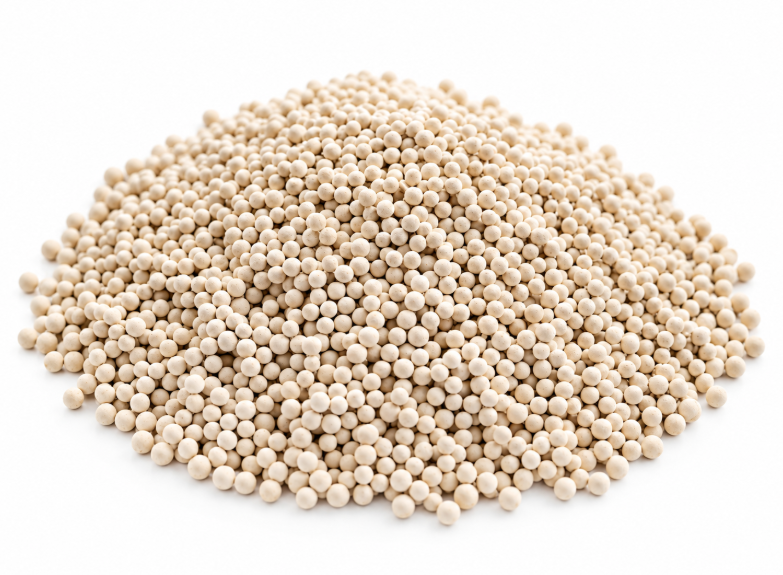
Sita molekularne 5A 3-5mm
Cena regularna:
Cena regularna:
towar niedostępny
dodaj do przechowalni
0


Opis
Molecular Sieves 5A
Other Names: Zeolite 5A, Calcium-Sodium Zeolite A, CaNaA Zeolite, Calcium-Exchanged Linde Type A Molecular Sieve
Chemical Formula: Ca4.5Na3[(AlO2)12(SiO2)12] · xH2O (representative composition)
Molar Mass: Variable, depending on calcium exchange and hydration state
CAS Number: 69912-79-4
Appearance: White to off-white crystalline powder, beads or granules
Odor: Odorless
Nominal Pore Size: 5 Å (0.5 nm)
Framework Type: LTA
SMILES: Not applicable (extended inorganic aluminosilicate framework without a unique molecular SMILES representation)
Molecular Sieves 5A are synthetic crystalline aluminosilicate adsorbents belonging to the Linde Type A (LTA) zeolite family. They are produced through partial ion exchange of sodium ions in zeolite 4A with divalent calcium ions. This modification changes the distribution of extra-framework cations and increases the effective accessibility of the pore openings to approximately 5 Å. The resulting material maintains the ordered three-dimensional aluminosilicate framework characteristic of zeolite A while allowing the adsorption of molecules that are too large to enter conventional 4A molecular sieves efficiently. Molecular Sieves 5A combine strong adsorption affinity with molecular-size discrimination and are extensively investigated in gas purification, hydrocarbon separation and adsorption-based industrial processes. Their pore structure makes them particularly valuable for distinguishing linear hydrocarbons from larger branched or cyclic molecules.
Chemical and physical properties
Molecular Sieves 5A are microporous, crystalline solids with a framework composed of interconnected SiO4 and AlO4 tetrahedra. The LTA structure contains cages connected by eight-membered oxygen rings. Calcium ion exchange modifies the occupation of cation sites around these openings, allowing relatively larger molecules to access the internal adsorption cavities.
The nominal effective pore size is approximately 5 Å, although actual molecular transport is influenced by adsorbate dimensions, molecular orientation, temperature and interactions with extra-framework cations. The calcium-to-sodium ratio can also affect adsorption capacity and selectivity.
The material is hydrophilic and exhibits a strong affinity for water vapor. Experimental studies have confirmed its ability to adsorb water over a range of relative humidities. The adsorption behavior depends on the concentration and distribution of calcium ions, the degree of hydration and the previous thermal treatment of the zeolite.
Zeolite 5A also adsorbs various gases and organic molecules through a combination of dispersion forces, electrostatic interactions and molecular confinement. Published studies have investigated adsorption of carbon dioxide, sulfur dioxide, hydrogen sulfide and normal alkanes, demonstrating the importance of molecular structure and adsorbent composition.
Molecular Sieves 5A are practically insoluble in water and common organic solvents. The inorganic framework is nonflammable and can undergo repeated adsorption and regeneration cycles under suitable operating conditions. Adsorption performance may deteriorate through pore contamination or exposure to chemically aggressive environments.
Applications
Molecular Sieves 5A are extensively used in the separation of linear hydrocarbons from branched-chain and cyclic hydrocarbons. Their pore dimensions allow normal paraffins to enter the internal cavities while restricting access to many bulkier isomers. This characteristic makes zeolite 5A valuable in adsorption-based hydrocarbon fractionation and purification.
They are also used for the dehydration of industrial gases and selected organic liquids. The combination of strong water affinity and relatively accessible micropores enables moisture removal from appropriately selected chemical streams.
In gas processing, molecular sieves 5A are investigated for carbon dioxide and hydrogen sulfide separation, including pressure-swing adsorption systems. Experimental studies have demonstrated their usefulness in separating mixtures containing carbon dioxide, methane and hydrogen sulfide.
In laboratory research, zeolite 5A serves as a model material for investigating adsorption thermodynamics, hydrocarbon diffusion, pore-size selectivity and the effects of calcium ion exchange. Spectroscopic and temperature-programmed desorption studies of normal alkanes provide insights into molecular confinement and adsorbate-framework interactions.
Scientific references
- Sun, M. et al. "Revisit the molecular sieving mechanism in LTA zeolites: does size really matter?" Adsorption, 31, 59 (2025). https://doi.org/10.1007/s10450-025-00616-5
- Sivasankar, N., Vasudevan, S. "Adsorption of n-Hexane in Zeolite-5A: A Temperature-Programmed Desorption and IR-Spectroscopic Study." Journal of Physical Chemistry B, 109, 15417–15421 (2005). https://doi.org/10.1021/jp0518714
- Liu, C. et al. "Unraveling the separation mechanisms of the LTA zeolite depending on the regulated particle size and pore structure for efficient ethylene/ethane separation." New Journal of Chemistry, 47, 12279 (2023). https://doi.org/10.1039/D3NJ01217D
- Tomadakis, M. M. et al. "Pressure-Swing Adsorption Separation of H2S from CO2 with Molecular Sieves 4A, 5A, and 13X." Separation Science and Technology, 46, 428–433 (2011). https://doi.org/10.1080/01496395.2010.520292
- Azhagapillai, P. et al. "Water Vapor Adsorption Capacity Loss of Molecular Sieves 4A, 5A, and 13X Resulting from Methanol and Heptane Exposure." ACS Omega, 7, 6463–6471 (2022). https://doi.org/10.1021/acsomega.1c03370
- Canosa, E. "Adsorbents for Pollution Reduction in Cultural Heritage Collections." Swedish National Heritage Board, Research and Development Report (2019). Scientific report
SAFETY
This product is considered as non-hazardous