
 PRODUKTY
- ORGANICZNE(1030)
- Tiole(1)
- Związki metaloorganiczne(1)
- Kwasy sulfonowe(6)
- Alkohole(74)
- Aldehydy(37)
- Azotyny Alkilowe(6)
- Aminy(45)
- Aminokwasy(52)
- Amidy(29)
- Bezwodniki(12)
- Halogenki Kwasowe(5)
- Kwasy karboksylowe(157)
- Barwniki, wskaźniki(92)
- Estry(41)
- Etery(18)
- Halogenki(27)
- Flawonoidy(5)
- Heterocykle(21)
- Węglowodory(31)
- Imidy(2)
- Ketony(25)
- Rozpuszczalniki (premix)(13)
- Związki Nitrowe(7)
- Nitryle(9)
- Sole organiczne(73)
- Fenole(30)
- Polimery(56)
- Cukry(18)
- Związki krzemoorganiczne oraz fosforoorganiczne(1)
- Peptydy(2)
- Terpeny(12)
- Inne(124)
- NIEORGANICZNE(894)
- SPRZĘT LABORATORYJNY(5151)
- *(1)
- Synteza organiczna(354)
- Przemysł(708)
Wersje językowe
Wersja US umożliwia dostawę do wszystkich dostępnych destynacji.


 Producenci
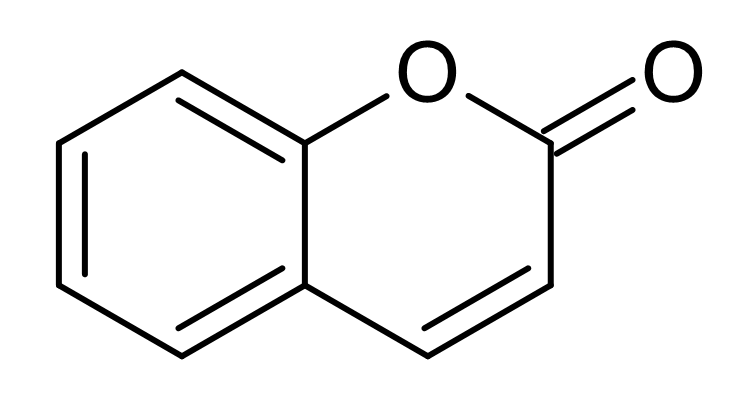
Kumaryna >99%
Cena regularna:
Cena regularna:
towar niedostępny
dodaj do przechowalni
0


Opis
Coumarin
Other Names: 2H-Chromen-2-one, 2H-1-Benzopyran-2-one, 1,2-Benzopyrone, Benzo-α-pyrone, Coumarine
Chemical Formula: C9H6O2
Molar Mass: 146.14 g/mol
CAS Number: 91-64-5
Appearance: White to colorless crystalline solid
Odor: Pleasant, sweet, hay-like odor with vanilla-like notes
SMILES: C1=CC=C2C(=C1)C=CC(=O)O2
Coumarin is an aromatic organic compound belonging to the benzopyrone family of oxygen-containing heterocycles. Its molecular structure consists of a benzene ring fused to an α-pyrone ring, forming a conjugated cyclic ester, commonly referred to as a lactone. This structural arrangement gives coumarin distinctive electronic, photochemical and chemical properties, making it an important compound in organic synthesis, materials science and photochemical research. Coumarin occurs naturally in various plant species and can also be produced synthetically through established organic reactions. Its characteristic sweet, herbaceous fragrance has contributed to its industrial importance as an aromatic ingredient in perfumery and cosmetic formulations. Beyond its fragrance properties, coumarin is widely investigated as a fundamental chemical scaffold for the preparation of functionalized heterocyclic compounds. Its conjugated ring system enables a variety of chemical transformations, while appropriately substituted coumarin derivatives exhibit valuable fluorescence and light-responsive properties. These characteristics have encouraged extensive research into coumarin-based molecular probes, fluorescent materials, photosensitive polymers and other functional organic compounds.
Chemical and physical properties
Coumarin is a crystalline solid under ambient conditions, generally appearing as colorless crystals, flakes or a white crystalline powder. Scientific reference data report a melting point of approximately 68–71 °C and a boiling point close to 300–302 °C under atmospheric pressure.
Coumarin is only slightly soluble in water but exhibits greater solubility in various organic solvents, including chloroform, diethyl ether and pyridine. Its limited aqueous solubility is associated with the presence of a relatively hydrophobic aromatic ring system, despite the polar oxygen-containing lactone group.
The conjugated benzopyrone structure strongly influences the electronic properties and ultraviolet absorption behavior of coumarin. The parent compound exhibits relatively weak fluorescence, whereas the introduction of suitable electron-donating or electron-withdrawing substituents can significantly modify its absorption and emission characteristics. This structural flexibility provides the foundation for the development of coumarin-based fluorescent dyes and analytical probes.
Coumarin also exhibits important photochemical reactivity. Under appropriate ultraviolet irradiation, coumarin units can undergo a photochemical [2+2] cycloaddition reaction, leading to the formation of cyclobutane-linked dimers. Under suitable irradiation conditions, these photodimers can undergo cleavage, allowing the reversible modification of molecular and polymer structures. This behavior has attracted considerable attention in the development of light-responsive materials.
From a synthetic perspective, the coumarin framework can undergo electrophilic substitution, functionalization and other transformations at different positions of its aromatic and heterocyclic rings. Established synthetic approaches to coumarin derivatives include the Pechmann, Perkin and Knoevenagel reactions, which provide access to a broad range of substituted benzopyrone compounds.
Applications
Coumarin is used in the fragrance and cosmetic industries as an aromatic ingredient and fragrance fixative. Its characteristic sweet, herbaceous odor makes it valuable in perfume compositions, scented soaps and other fragranced formulations. It can also function as an odor-masking component in selected industrial products.
In organic synthesis, coumarin serves as a starting material and structural building block for the preparation of numerous substituted heterocyclic compounds. Chemical modifications of the benzopyrone framework enable the production of derivatives with tailored electronic, physicochemical and biological properties. Coumarin-based structures are particularly important in medicinal chemistry research, where functionalized derivatives are investigated for a variety of biological activities.
Coumarin derivatives are extensively studied in fluorescence spectroscopy and analytical chemistry. Appropriately substituted coumarin fluorophores are used in the development of fluorescent probes for detecting metal ions, reactive chemical species and selected molecular targets. Their tunable optical properties also support applications in fluorescence imaging, chemical sensing and photophysical investigations.
In materials science, coumarin-containing compounds are investigated for the preparation of photoresponsive polymers and functional coatings. The photochemical dimerization and cleavage of coumarin groups can be used to control polymer cross-linking, network formation and structural rearrangement. These mechanisms are particularly relevant to research on reversible polymer networks, self-healing materials and light-responsive surfaces.
Coumarin is also an important precursor for the synthesis of specialized fluorescent dyes and optical materials. Selected coumarin derivatives exhibit high fluorescence quantum yields, favorable photostability and tunable emission characteristics, making them useful in dye-laser research and advanced photonic systems.
In laboratory research, coumarin is employed as a model heterocyclic compound in studies of molecular spectroscopy, excited-state dynamics, photochemical reactions, organic synthesis and structure–property relationships. Its relatively simple and well-defined molecular architecture makes it especially useful for investigating how chemical substitution affects the reactivity and optical behavior of conjugated organic systems.
Scientific references
1. International Agency for Research on Cancer (IARC). Coumarin. IARC Monographs on the Evaluation of Carcinogenic Risks to Humans, Volume 77, Some Industrial Chemicals, 2000.
https://www.ncbi.nlm.nih.gov/books/NBK390898/
2. Citarella, A., Vittorio, S., Dank, C., & Ielo, L. (2024). Syntheses, reactivity, and biological applications of coumarins. Frontiers in Chemistry, 12, 1362992.
https://doi.org/10.3389/fchem.2024.1362992
3. Safavi-Mirmahalleh, S.-A., et al. (2023). A review on applications of coumarin and its derivatives in preparation of photo-responsive polymers. European Polymer Journal, 198, 112430.
https://doi.org/10.1016/j.eurpolymj.2023.112430
4. Szwaczko, K., Kulkowska, A., & Matwijczuk, A. (2026). Advances in Coumarin Fluorescent Probes for Medical Diagnostics: A Review of Recent Developments. Biosensors, 16(1), 36.
https://doi.org/10.3390/bios16010036
5. Boisde, P. M., & Meuly, W. C. (2000). Coumarin. Kirk-Othmer Encyclopedia of Chemical Technology. Wiley.
https://doi.org/10.1002/0471238961.0315211302150919.a01
6. National Center for Biotechnology Information (NCBI). PubChem Compound Summary for CID 323, Coumarin. PubChem Database.
https://pubchem.ncbi.nlm.nih.gov/compound/323
Informacje dotyczące bezpieczeństwa

Hasło ostrzegawcze: ⚠️ Warning
Zwroty zagrożenia:
-
H301: Działa toksycznie po połknięciu.
-
H412: Działa szkodliwie na organizmy wodne, powodując długotrwałe skutki.
Zwroty ostrożności – zapobieganie:
-
P273: Unikać uwolnienia do środowiska.
-
P280: Stosować rękawice ochronne/odzież ochronną/ochronę oczu/ochronę twarzy.
Zwroty ostrożności – reagowanie:
-
P301+P310: IF SWALLOWED: Immediately call a POISON CENTER or doctor.
Postępowanie i przechowywanie
-
Postępowanie: Unikać kontaktu ze skórą, oczami i odzieżą. Zapobiegać powstawaniu pyłu
-
Przechowywanie: Przechowywać pojemnik szczelnie zamknięty w chłodnym, suchym, dobrze wentylowanym miejscu. Chronić przed światłem i wilgocią
Względy środowiskowe
Wysoce toksyczny dla organizmów wodnych. Unikać uwolnienia do środowiska. Rozlewiska należy niezwłocznie ograniczyć i usunąć.