
 PRODUKTY
- ORGANICZNE(1115)
- Tiole(1)
- Związki metaloorganiczne(1)
- Alkohole(74)
- Aldehydy(43)
- Azotyny Alkilowe(6)
- Aminy(55)
- Aminokwasy(55)
- Amidy(33)
- Bezwodniki(11)
- Halogenki Kwasowe(5)
- Kwasy karboksylowe(167)
- Barwniki, wskaźniki(95)
- Estry(52)
- Etery(17)
- Halogenki(30)
- Flawonoidy(5)
- Heterocykle(25)
- Węglowodory(38)
- Imidy(1)
- Ketony(29)
- Rozpuszczalniki (premix)(16)
- Związki Nitrowe(7)
- Nitryle(9)
- Sole organiczne(73)
- Fenole(30)
- Polimery(64)
- Cukry(24)
- Związki krzemoorganiczne oraz fosforoorganiczne(1)
- Peptydy(2)
- Terpeny(16)
- Inne(126)
- NIEORGANICZNE(1022)
- SPRZĘT LABORATORYJNY(5155)
- *(1)
- Synteza organiczna(416)
- Przemysł(767)
Wersje językowe
Wersja US umożliwia dostawę do wszystkich dostępnych destynacji.


 Producenci
Kofeina Bezwodna >99,9%
Cena regularna:
Cena regularna:
towar niedostępny
dodaj do przechowalni
4


Opis
Caffeine
Other Names: 1,3,7-Trimethylxanthine, 1,3,7-Trimethyl-1H-purine-2,6-dione, Methyltheobromine, Coffeine, Theine
Chemical Formula: C8H10N4O2
Molar Mass: 194.19 g/mol
CAS Number: 58-08-2
Appearance: White crystalline powder or colorless to white crystalline needles
Odor: Odorless
SMILES: CN1C=NC2=C1C(=O)N(C(=O)N2C)C
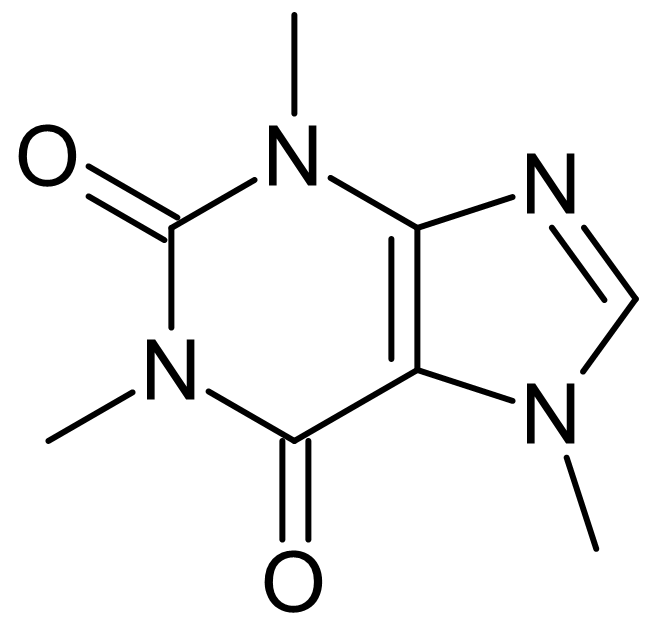
Caffeine is a naturally occurring methylxanthine alkaloid belonging to the purine-derived xanthine family. Chemically, it is 1,3,7-trimethylxanthine and contains a fused heterocyclic purine-like ring system with three N-methyl substituents and two carbonyl groups. The combination of carbonyl oxygen atoms and ring nitrogen atoms gives the molecule significant hydrogen-bond-accepting capability and influences its interactions with solvents, proteins and biological receptors.
The molecular structure of caffeine is relatively rigid and planar, and its electronic system produces characteristic ultraviolet absorption that is frequently exploited in analytical chemistry. Caffeine is also an extensively investigated reference compound in crystallography, thermodynamics, spectroscopy, chromatography and pharmaceutical research.
Chemical and physical properties
Caffeine is a crystalline solid under ambient conditions. Experimental phase-transition measurements compiled by the NIST Chemistry WebBook report a fusion temperature of approximately 508–509 K, corresponding to about 235–236 °C. At elevated temperatures caffeine can also undergo substantial sublimation, and thermochemical measurements have reported enthalpies of sublimation of approximately 104–113 kJ/mol depending on the experimental temperature range and method.
Caffeine has a molar mass of 194.19 g/mol and is moderately soluble in water. Reported experimental data indicate a water solubility of approximately 2.17 g/100 mL near room temperature. Its solubility increases significantly with increasing temperature, an important property in laboratory purification and recrystallization procedures.
The molecule contains no conventional hydrogen-bond donor groups, but its carbonyl oxygen atoms and several nitrogen centers act as hydrogen-bond acceptors. Consequently, caffeine can participate in specific intermolecular interactions with water and other hydrogen-bond-donating molecules. These interactions influence its crystal packing, solvation and dissolution behavior.
Caffeine is sufficiently thermally stable to permit investigation by sublimation and vapor-phase techniques, although heating near or above its melting region can be accompanied by phase transitions and decomposition depending on experimental conditions. Its vaporization and sublimation thermodynamics have therefore been examined extensively using calorimetric and spectroscopic methods.
The conjugated heterocyclic structure gives caffeine characteristic UV absorption, enabling sensitive quantitative determination by UV-visible spectrophotometry and high-performance liquid chromatography with UV detection.
Applications
Caffeine is extensively used as a reference standard and analytical reagent in chromatographic and spectroscopic methods. It is commonly employed in HPLC, UV-visible spectrophotometry, mass spectrometry and related analytical techniques for method development, calibration and validation.
In biochemical and pharmacological research, caffeine is widely used as a non-selective antagonist of adenosine receptors. Its interactions with A1, A2A, A2B and A3 receptor subtypes have made it an important experimental tool for investigating purinergic signaling, neurotransmission and receptor-mediated cellular responses.
Caffeine is also used in molecular and cellular research involving cyclic nucleotide signaling, calcium regulation and enzyme activity. At sufficiently high experimental concentrations it can influence phosphodiesterase activity and intracellular calcium-related pathways, although these mechanisms generally require concentrations different from those associated with its principal adenosine-receptor interactions.
In pharmaceutical research and quality-control laboratories, caffeine can serve as an active reference compound, system-suitability standard and model analyte for evaluating extraction, separation and quantification procedures. Its well-characterized structure, UV absorption and chromatographic behavior make it particularly suitable for analytical method development.
Caffeine is additionally used as a model organic compound in studies of crystallization, polymorphism, co-crystal formation, solubility, thermodynamics and intermolecular interactions. Its ability to form defined crystalline structures with other molecules has made it useful in supramolecular chemistry and pharmaceutical solid-state research.
Scientific references
- National Institute of Standards and Technology. NIST Chemistry WebBook, SRD 69: Caffeine, CAS 58-08-2. Phase-change, thermochemical, spectroscopic and mass-spectral data.
- National Center for Biotechnology Information. PubChem Compound Summary for CID 2519, Caffeine. Molecular structure, identifiers and physicochemical properties.
- Müller, C. E.; Jacobson, K. A. “Xanthines as Adenosine Receptor Antagonists.” Handbook of Experimental Pharmacology, 2011, 200, 151–199. DOI: 10.1007/978-3-642-13443-2_6.
- Rivera-Oliver, M.; Díaz-Ríos, M. “Using Caffeine and Other Adenosine Receptor Antagonists and Agonists as Therapeutic Tools against Neurodegenerative Diseases: A Review.” Life Sciences, 2014, 101, 1–9. DOI: 10.1016/j.lfs.2014.01.083.
- Ferré, S. “Mechanisms of the Psychostimulant Effects of Caffeine: Implications for Substance Use Disorders.” Psychopharmacology, 2016, 233, 1963–1979. DOI: 10.1007/s00213-016-4212-2.
- Bonaventura, J.; Navarro, G.; Casadó-Anguera, V.; et al. “Allosteric Interactions between Agonists and Antagonists within the Adenosine A2A Receptor–Dopamine D2 Receptor Heterotetramer.” Proceedings of the National Academy of Sciences of the United States of America, 2015, 112, E3609–E3618. DOI: 10.1073/pnas.1507704112.
- Boller, A.; Wiedemann, H. G. Thermochemical investigations of caffeine including vaporization and sublimation behavior, as compiled in the NIST Chemistry WebBook.
- Guo, K.; Sadiq, G.; Seaton, C.; Davey, R.; Yin, Q. Experimental studies of caffeine solid-state and fusion thermodynamics, as compiled in the NIST Chemistry WebBook.

Safety
Signal Word: Warning
Hazard Statements
H302: Harmful if swallowed.
Precautionary Statements
P101: If medical advice is needed, have product container or label at hand.
P102: Keep out of reach of children.
P264: Wash hands thoroughly after handling.
P270: Do not eat, drink or smoke when using this product.
P301+P312: IF SWALLOWED: Call a doctor if you feel unwell.
P501: Dispose of contents/container to an authorized waste disposal facility.
First Aid Measures
Eye Contact: Rinse immediately with water for at least 10 minutes. Remove contact lenses if present.
Skin Contact: Rinse with lukewarm water and mild soap. Remove contaminated clothing.
Inhalation: Move to fresh air. Seek medical attention if symptoms persist.
Ingestion: Rinse mouth. Drink 200–500 mL of water. Do not induce vomiting. Seek medical attention.
Handling and Storage
Storage Conditions: Store in a dry, cool, and well-ventilated place. Protect from moisture and incompatible materials.
Handling Precautions: Avoid dust formation. Use appropriate protective equipment.