
 PRODUKTY
- ORGANICZNE(1030)
- Tiole(1)
- Związki metaloorganiczne(1)
- Kwasy sulfonowe(6)
- Alkohole(74)
- Aldehydy(37)
- Azotyny Alkilowe(6)
- Aminy(45)
- Aminokwasy(52)
- Amidy(29)
- Bezwodniki(12)
- Halogenki Kwasowe(5)
- Kwasy karboksylowe(157)
- Barwniki, wskaźniki(92)
- Estry(41)
- Etery(18)
- Halogenki(27)
- Flawonoidy(5)
- Heterocykle(21)
- Węglowodory(31)
- Imidy(2)
- Ketony(25)
- Rozpuszczalniki (premix)(13)
- Związki Nitrowe(7)
- Nitryle(9)
- Sole organiczne(73)
- Fenole(30)
- Polimery(56)
- Cukry(18)
- Związki krzemoorganiczne oraz fosforoorganiczne(1)
- Peptydy(2)
- Terpeny(12)
- Inne(124)
- NIEORGANICZNE(894)
- SPRZĘT LABORATORYJNY(5151)
- *(1)
- Synteza organiczna(354)
- Przemysł(708)
Wersje językowe
Wersja US umożliwia dostawę do wszystkich dostępnych destynacji.


 Producenci
Glikol dibutylowy (Butylodiglikol) BDG
Cena regularna:
Cena regularna:
towar niedostępny
dodaj do przechowalni
0

 BDG "Pin It")
Opis
Butyldiglycol
Other Names: Diethylene Glycol Monobutyl Ether, Diethylene Glycol Mono-n-butyl Ether, 2-(2-Butoxyethoxy)ethanol, Butyl Diglycol, Butyl Carbitol, Butoxydiglycol, DEGBE, DEGMBE, Butyldigol, 3,6-Dioxadecan-1-ol
Chemical Formula: C8H18O3
Molar Mass: 162.23 g/mol
CAS Number: 112-34-5
EC Number: 203-961-6
Appearance: Clear, colorless liquid
Odor: Mild, characteristic ether-like odor
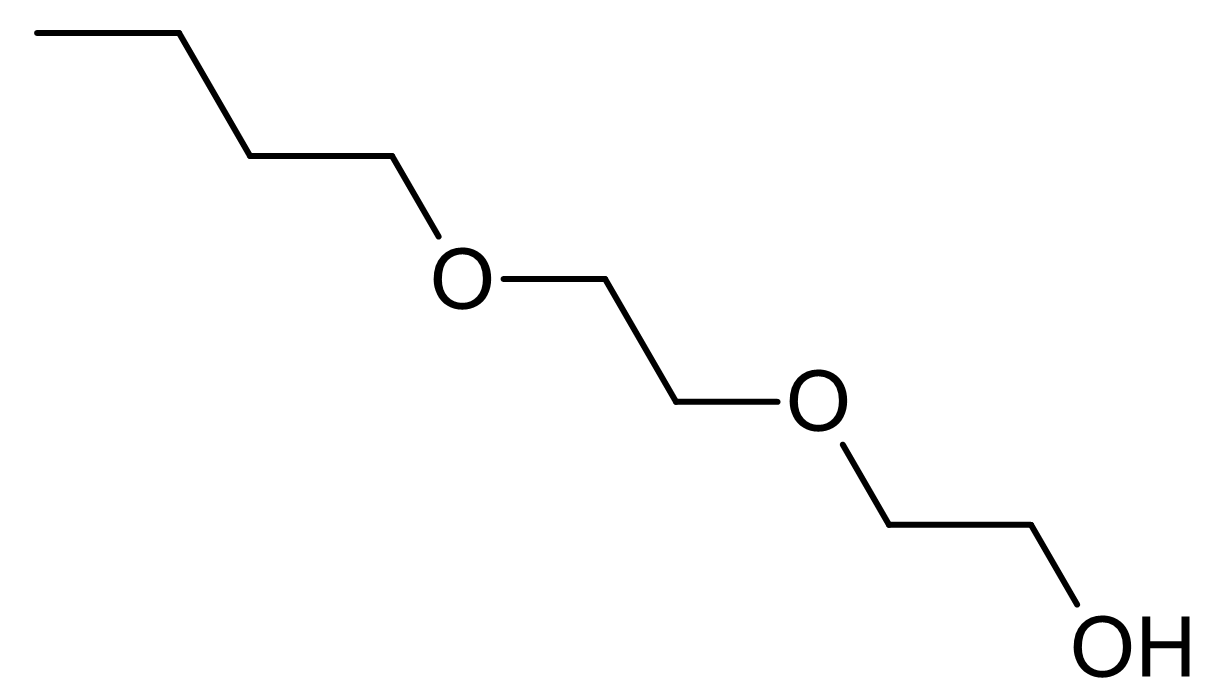
SMILES: CCCCOCCOCCO
Butyldiglycol, also known as diethylene glycol monobutyl ether or 2-(2-butoxyethoxy)ethanol, is an organic compound belonging to the family of glycol ethers. Its molecular structure consists of a diethylene glycol chain in which one terminal hydroxyl group is replaced by an n-butoxy group, while the other remains available as a primary alcohol functionality. This arrangement combines the hydrophilic properties of ether oxygen atoms and a hydroxyl group with the hydrophobic character of a four-carbon alkyl chain. As a result, Butyldiglycol exhibits excellent solvent compatibility with water and numerous organic compounds. It is a high-boiling, relatively low-volatility liquid widely used as an industrial solvent, coupling agent, coalescing agent and chemical processing aid. Its balanced polar and nonpolar characteristics make it particularly useful in aqueous and solvent-based formulations, including coatings, inks, cleaning systems and polymer processing applications. Butyldiglycol has also attracted scientific interest because of its hydrogen-bonding behavior, molecular interactions with water and influence on phase equilibria in multicomponent liquid systems. Experimental investigations have examined its density, viscosity, refractive index, excess molar volume and thermodynamic behavior. These properties make it a valuable model compound in solution chemistry, chemical engineering and the development of advanced solvent formulations.
Chemical and physical properties
Butyldiglycol is a clear, colorless liquid under normal ambient conditions. Published physicochemical data report a melting point of approximately −68 °C and a normal boiling point of approximately 230 °C at atmospheric pressure. Its relatively high boiling point is associated with the presence of ether linkages and a terminal hydroxyl group, which contribute to intermolecular interactions and hydrogen bonding.
The density of Butyldiglycol is approximately 0.953–0.955 g/cm3 at 20 °C. Its refractive index (nD20) is approximately 1.43. The compound exhibits relatively low vapor pressure at room temperature compared with more volatile industrial solvents, making it useful in formulations where slower evaporation and extended working time are desirable.
Butyldiglycol is completely miscible with water at ordinary temperatures and dissolves readily in many organic solvents, including alcohols, ketones and ethers. Its favorable solubility characteristics arise from the combination of polar ether and hydroxyl functionalities with a nonpolar butyl group. This amphiphilic molecular structure enables the compound to act as a coupling solvent in formulations containing components with different polarities.
Experimental investigations of binary mixtures containing Butyldiglycol and water have demonstrated significant deviations from ideal mixing behavior. Measurements performed between 293.15 K and 333.15 K revealed negative excess molar volumes, indicating that molecular packing and intermolecular interactions in the mixtures differ from those expected for ideal solutions. These observations are associated with hydrogen bonding and the structural organization of the mixed liquids.
The molecular interactions of Butyldiglycol with water have also been investigated through density, speed-of-sound and refractive-index measurements. Studies of aqueous glycol ether solutions at 298.15 K have provided information about apparent molar volumes, isentropic compressibility and intermolecular association. Such measurements are important for understanding the behavior of glycol ether solvents in industrial and laboratory formulations.
Butyldiglycol contains a primary alcohol group that can undergo typical chemical transformations, including oxidation and esterification. Oxidation under suitable conditions may produce the corresponding aldehyde and subsequently the carboxylic acid derivative. Esterification of the hydroxyl group with appropriate carboxylic acids can produce glycol ether esters with modified solvent properties.
The compound is combustible, with a reported closed-cup flash point of approximately 78 °C, although values can vary depending on the measurement method. Its high boiling point and moderate evaporation rate should not be interpreted as an absence of fire or handling hazards. Appropriate industrial ventilation and chemical handling procedures remain necessary.
Applications
Butyldiglycol is widely used as a solvent in industrial coatings, paints and varnishes. Its ability to dissolve or compatibilize a broad range of organic substances makes it useful in formulations containing resins, pigments and other functional additives. In waterborne coating systems, it can act as a coalescing solvent by assisting the formation of continuous polymer films during the drying process. Its relatively slow evaporation provides additional time for polymer particle deformation and film formation, which can influence coating uniformity, surface appearance and application performance.
In the production of printing inks, Butyldiglycol is employed as a solvent and formulation component. Its combination of water compatibility, organic solvency and relatively low volatility makes it useful in systems where controlled drying, viscosity adjustment and uniform distribution of dissolved components are required. It can contribute to the stability and processing properties of aqueous and mixed-solvent ink formulations.
Butyldiglycol is also used in industrial and technical cleaning formulations. Its molecular structure enables interactions with both polar and relatively nonpolar substances, making it suitable for cleaning systems designed to remove oils, greases, resins and other organic residues. It is frequently employed as a coupling solvent to improve the compatibility of different ingredients in aqueous cleaning solutions.
In polymer chemistry, Butyldiglycol is used as a processing solvent and formulation aid. It can assist in dissolving or dispersing selected polymers, resins and additives, depending on their chemical composition. Its high boiling point and relatively slow evaporation are useful in applications requiring extended processing times, controlled film formation or adjustment of solution viscosity.
Scientific research has investigated Butyldiglycol as a cosurfactant in microemulsion systems. A study published in the Journal of Dispersion Science and Technology examined the influence of alcohols and glycol ethers, including diethylene glycol monobutyl ether, on the phase behavior and solubilization capacity of systems containing sodium dodecyl sulfate, aqueous sodium chloride and organic oils. The results demonstrated that cosurfactant molecular structure and hydrocarbon chain length influence the formation and stability of microemulsion regions. These findings are relevant to the development of specialized cleaning formulations, dispersion systems and solvent-based technologies.
Butyldiglycol is also an important model compound in liquid–liquid equilibrium research. Experimental studies have investigated ternary mixtures containing water, hydrocarbons and diethylene glycol monobutyl ether. Measurements involving water, octane and Butyldiglycol at temperatures between 283.15 K and 303.15 K demonstrated the importance of solvent composition and temperature in determining phase separation behavior. The resulting equilibrium data were successfully correlated using the UNIQUAC thermodynamic model.
Additional research involving water, decane and Butyldiglycol has provided experimental liquid–liquid equilibrium data at 20, 30 and 40 °C. These studies support the development and validation of thermodynamic models used in chemical process simulation, solvent selection and liquid-phase separation technologies.
In chemical engineering, Butyldiglycol is investigated as a representative high-boiling glycol ether for studies of viscosity, molecular association and thermodynamic properties. Experimental data on its binary mixtures with water are used to evaluate excess molar volumes, viscosity deviations and solution compressibility. Such information is essential for modeling fluid behavior and optimizing industrial processes involving solvent mixtures.
In analytical chemistry, Butyldiglycol serves as a reference compound for the characterization of glycol ether solvents. Its molecular structure and purity can be investigated using gas chromatography, mass spectrometry, infrared spectroscopy and nuclear magnetic resonance spectroscopy. These analytical techniques are applied in solvent identification, quality control and investigations of chemical transformations.
Butyldiglycol is additionally used as a technical solvent in specialty chemical formulations and industrial processing systems. Its combination of water miscibility, high boiling point, favorable solvency and relatively slow evaporation makes it particularly valuable where compatibility between aqueous and organic components is required.
Scientific references
1. National Institute of Standards and Technology (NIST). Chemistry WebBook, SRD 69: Ethanol, 2-(2-butoxyethoxy)-. Chemical identification, molecular formula, molecular mass, phase-change data, thermochemical properties and infrared and mass spectra.
https://webbook.nist.gov/cgi/cbook.cgi?ID=C112345
2. National Center for Biotechnology Information (NCBI). PubChem Compound Summary: Diethylene Glycol Monobutyl Ether, CID 8177. Molecular structure, physicochemical properties, chemical identifiers, solubility data, industrial applications and canonical SMILES representation.
https://pubchem.ncbi.nlm.nih.gov/compound/8177
3. Li, X.-X.; Zhao, G.; Liu, D.-S.; Cao, W.-W. (2009). Excess Molar Volume and Viscosity Deviation for the Binary Mixture of Diethylene Glycol Monobutyl Ether + Water from (293.15 to 333.15) K at Atmospheric Pressure. Journal of Chemical & Engineering Data, 54(3), 890–892. Experimental investigation of density, viscosity, excess molar volume and intermolecular interactions in aqueous Butyldiglycol mixtures.
https://doi.org/10.1021/je800684x
4. Dhondge, S. S.; Pandhurnekar, C. P.; Parwate, D. V. (2010). Density, Speed of Sound, and Refractive Index of Aqueous Binary Mixtures of Some Glycol Ethers at T = 298.15 K. Journal of Chemical & Engineering Data, 55(9), 3962–3968. Study of physicochemical properties, hydrogen bonding, excess molar volumes and compressibility in aqueous glycol ether solutions, including diethylene glycol monobutyl ether.
https://doi.org/10.1021/je901072c
5. Liu, Y.-L.; Chiou, D.-R.; Chen, L.-J. (2002). Liquid–Liquid Equilibria for the Ternary System Water + Octane + Diethylene Glycol Monobutyl Ether. Journal of Chemical & Engineering Data, 47(2), 310–312. Experimental determination of liquid–liquid equilibrium data at 283.15, 293.15 and 303.15 K and thermodynamic correlation using the UNIQUAC model.
https://doi.org/10.1021/je015517k
6. Liu, Y.-L.; Lin, B.-J.; Chen, L.-J. (2003). Liquid–Liquid Equilibria for the Ternary System Water + Decane + Diethylene Glycol Monobutyl Ether at 20 °C, 30 °C, and 40 °C. Journal of Chemical & Engineering Data, 48(2), 333–336. Experimental analysis of ternary liquid-phase equilibria and thermodynamic modeling of water–hydrocarbon–glycol ether systems.
https://doi.org/10.1021/je0255776
7. Adamy, S. T. (1994). Effects of Cosurfactant and Oil Chain Length on Phase Behavior and Solubilization in Alcohol and Glycol Ether Microemulsions. Journal of Dispersion Science and Technology, 15(6), 727–748. Investigation of glycol ethers, including diethylene glycol monobutyl ether, as cosurfactants in microemulsion systems and their influence on phase behavior and solubilization.
https://doi.org/10.1080/01932699408943587
8. Chiao, T. (1961). Densities and Refractive Indices of Diethylene Glycol Ether-Water Solutions. Diethylene Glycol Monomethyl, Monoethyl, and Monobutyl Ethers. Journal of Chemical & Engineering Data, 6(2), 192–193. Experimental investigation of density and refractive-index behavior in aqueous solutions of diethylene glycol ethers.
https://doi.org/10.1021/je60010a006
SAFETY

UWAGA Zwroty wskazujące rodzaj zagrożenia Działa drażniąco na oczy. Zwroty wskazujące środki ostrożności W PRZYPADKU DOSTANIA SIĘ DO OCZU: Ostrożnie płukać wodą przez kilka minut. Wyjąć soczewki kontaktowe, jeżeli są i można je łatwo usunąć. Nadal płukać.