
 PRODUKTY
- ORGANICZNE(1030)
- NIEORGANICZNE(894)
- Kwasy mineralne(40)
- Chelaty(2)
- Pierwiastki(115)
- Sole(509)
- Tlenki(119)
- Wodorotlenki(26)
- Wodorki(14)
- Inne(20)
- Nanocząstki(1)
- Roztwory mianowane(47)
- SPRZĘT LABORATORYJNY(5151)
- *(1)
- Synteza organiczna(354)
- Przemysł(708)
Wersje językowe
Wersja US umożliwia dostawę do wszystkich dostępnych destynacji.


 Producenci
Chlorek Potasu Tech.
Cena regularna:
Cena regularna:
towar niedostępny
dodaj do przechowalni
0

Opis
Potassium Chloride
Other Names: Potassium Monochloride, Potassium Salt of Hydrochloric Acid, Sylvite, Sylvine
Chemical Formula: KCl
Molar Mass: 74.55 g/mol
CAS Number: 7447-40-7
EC Number: 231-211-8
Appearance: White crystalline powder, colorless crystals or granules
Odor: Odorless
SMILES: [K+].[Cl-]
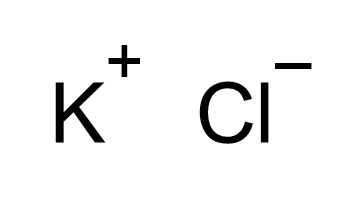
Potassium chloride is an inorganic ionic compound consisting of potassium cations (K+) and chloride anions (Cl−) in a 1:1 molar ratio. It belongs to the family of alkali metal halides and is characterized by a highly ordered cubic crystal structure. In the solid state, potassium chloride adopts the rock-salt structure, in which each potassium ion is surrounded by six chloride ions and each chloride ion is coordinated by six potassium ions. This arrangement creates a stable three-dimensional ionic lattice held together by electrostatic interactions. Potassium chloride occurs naturally as the mineral sylvite and can also be obtained through crystallization and purification processes. Its well-defined chemical composition, high water solubility and predictable electrolyte behavior make it a valuable compound in analytical chemistry, electrochemistry, crystallography and materials science. When dissolved in water, potassium chloride dissociates into hydrated potassium and chloride ions, producing an electrically conductive solution. Its aqueous solutions are extensively investigated as reference systems for studying ionic conductivity, thermodynamic activity, solvation and molecular transport. Potassium chloride is also commonly used in electrochemical reference electrodes, conductivity calibration solutions and experimental investigations of crystallization and solid-liquid equilibria.
Chemical and physical properties
Potassium chloride is a white or colorless crystalline solid under ambient conditions. Published physicochemical data report a melting point of approximately 770 °C and a boiling point of approximately 1420 °C at atmospheric pressure. Its high melting temperature is associated with the strong electrostatic interactions between potassium and chloride ions within the crystalline lattice.
The density of crystalline potassium chloride is approximately 1.984 g/cm3 at 20 °C. Its crystal structure belongs to the cubic crystal system, with space group Fm-3m. The lattice contains two interpenetrating face-centered cubic ionic sublattices, giving both potassium and chloride ions octahedral coordination. This structure makes potassium chloride an important reference compound in solid-state chemistry and crystallographic investigations.
Potassium chloride is highly soluble in water. Reference solubility data indicate that approximately 34.2 g of KCl dissolve in 100 g of water at 20 °C, increasing to approximately 35.5 g per 100 g of water at 25 °C. Its solubility increases significantly with temperature, making temperature-dependent crystallization an important method for investigating its solid-liquid equilibrium behavior.
Experimental studies have demonstrated that the solubility of potassium chloride is strongly influenced by solvent composition. Measurements in aqueous ethanol mixtures show that introducing an organic component changes the solvation environment and reduces the ability of the solvent to stabilize dissolved ions. These effects are important in separation processes, crystallization studies and investigations of electrolyte phase equilibria.
In aqueous solution, potassium chloride behaves as a strong electrolyte and dissociates into K+ and Cl− ions. The resulting solution exhibits electrical conductivity that depends on concentration and temperature. Precise conductivity measurements performed on potassium chloride reference solutions have established highly reproducible values. For example, an aqueous KCl solution with a molality of 0.01 mol/kg exhibits an electrolytic conductivity of approximately 1.40823 mS/cm at 25 °C under defined reference conditions.
The dissolved potassium and chloride ions interact with surrounding water molecules through ion-dipole forces. Molecular dynamics simulations and neutron scattering studies have demonstrated the importance of hydration structures and ion-water interactions in determining the behavior of aqueous KCl solutions. Raman spectroscopic investigations have also provided evidence of ion-pair formation, particularly at elevated electrolyte concentrations. Such interactions influence molecular organization, thermodynamic properties and transport phenomena.
Potassium chloride is practically insoluble in several nonpolar organic solvents and exhibits very limited solubility in ethanol. It is a nonflammable inorganic compound and is chemically stable under normal storage conditions. In aqueous systems, chloride ions can participate in precipitation reactions with silver ions, producing sparingly soluble silver chloride. This reaction forms the basis of several classical analytical methods for chloride determination.
Applications
Potassium chloride is extensively used in analytical chemistry for preparing electrolyte solutions of accurately defined composition. High-purity potassium chloride is particularly valuable in the preparation of conductivity reference solutions used for calibrating conductivity meters and verifying measurement cell constants. Its well-characterized electrical conductivity makes it a primary reference material in electrochemical metrology. Published studies from the National Institute of Standards and Technology have established precise conductivity values for potassium chloride solutions over a broad range of concentrations and temperatures.
In electrochemistry, potassium chloride is widely employed as an electrolyte in silver/silver chloride (Ag/AgCl) reference electrodes. Concentrated or saturated KCl solutions provide a controlled chloride ion activity, contributing to the stability and reproducibility of the reference electrode potential. Potassium chloride solutions are also frequently used in salt bridges, where the relatively similar ionic mobilities of K+ and Cl− help minimize liquid junction potentials in many electrochemical measurement systems.
Potassium chloride is used in physicochemical investigations of aqueous electrolyte systems. Its solutions serve as model systems for measuring ionic conductivity, activity coefficients, osmotic coefficients and diffusion properties. Experimental and theoretical studies involving potassium chloride contribute to the development and validation of electrolyte thermodynamic models, including equations describing nonideal ionic interactions in aqueous solutions.
In crystallography and materials science, potassium chloride is investigated as a representative ionic crystal with a simple cubic lattice. Its structural properties make it suitable for studying lattice dynamics, crystal defects, ionic interactions, surface behavior and solid-state transformations. Single crystals of potassium chloride are also used in selected optical and infrared spectroscopy applications because of their transmission properties in parts of the infrared spectral region.
Potassium chloride is additionally employed in laboratory research on crystallization, nucleation and crystal growth. Experimental studies have investigated the formation of KCl crystals under controlled cooling and stirring conditions, providing information about nucleation kinetics, growth rates and crystal size distributions. These investigations are relevant to the development of crystallization technologies and the purification of inorganic compounds.
In chemical analysis, potassium chloride is used for preparing chloride reference solutions and evaluating analytical methods based on precipitation reactions, potentiometric measurements and ion-selective electrodes. The formation of silver chloride upon reaction with silver nitrate makes KCl useful in classical argentometric analysis and in investigations of precipitation equilibria.
Potassium chloride also serves as an electrolyte in corrosion research, membrane transport studies and investigations of ion-selective materials. Controlled KCl solutions allow researchers to examine the influence of chloride concentration on electrochemical reactions, ion diffusion, membrane permeability and the stability of metallic surfaces. Its predictable dissociation behavior and well-established physicochemical properties make it a versatile reagent for laboratory and industrial research.
Scientific references
- Wu, Y. C., Koch, W. F., Pratt, K. W. "Proposed New Electrolytic Conductivity Primary Standards for KCl Solutions." Journal of Research of the National Institute of Standards and Technology, 96(2), 191–201 (1991). https://doi.org/10.6028/jres.096.008
- Wu, Y. C., Berezansky, P. A. "Low Electrolytic Conductivity Standards." Journal of Research of the National Institute of Standards and Technology, 100(5), 521–527 (1995). https://doi.org/10.6028/jres.100.039
- Pinho, S. P., Macedo, E. A. "Solubility of NaCl, NaBr, and KCl in Water, Methanol, Ethanol, and Their Mixed Solvents." Journal of Chemical & Engineering Data, 50(1), 29–32 (2005). https://doi.org/10.1021/je049922y
- Partanen, J. I. "Mean Activity Coefficients and Osmotic Coefficients in Dilute Aqueous Sodium or Potassium Chloride Solutions at Temperatures from (0 to 70) °C." Journal of Chemical & Engineering Data, 61(1), 286–306 (2016). https://doi.org/10.1021/acs.jced.5b00544
- Mason, P. E. et al. "Molecular Dynamics and Neutron Scattering Studies of Potassium Chloride in Aqueous Solution." Journal of Physical Chemistry B, 123(50), 10807–10813 (2019). https://doi.org/10.1021/acs.jpcb.9b08422
- Wang, L. et al. "Identification of Ion Pairs in Aqueous NaCl and KCl Solutions in Combination with Raman Spectroscopy, Molecular Dynamics, and Quantum Chemical Calculations." Journal of Physical Chemistry B, 127(7), 1618–1627 (2023). https://doi.org/10.1021/acs.jpcb.2c07923
- Hassel, A. W., Fushimi, K., Seo, M. "An Agar-Based Silver|Silver Chloride Reference Electrode for Use in Micro-Electrochemistry." Electrochemistry Communications, 1(5), 180–183 (1999). https://doi.org/10.1016/S1388-2481(99)00035-1
- Zheng, D. et al. "Nonisothermal Crystallization Kinetics of Potassium Chloride Produced by Stirred Crystallization." Journal of Crystal Growth, 2023, 127035. https://doi.org/10.1016/j.jcrysgro.2022.127035
SAFETY:
This substance is not considered dangerous according to GHS