Acetonitrile
Other Names: Methyl cyanide, Cyanomethane, Ethanenitrile, Ethyl nitrile, Methanecarbonitrile, MeCN
Chemical Formula: C2H3N
Molar Mass: 41.05 g/mol
CAS Number: 75-05-8
SMILES: CC#N
Appearance: Colorless, transparent liquid
Odor: Characteristic, ether-like odor
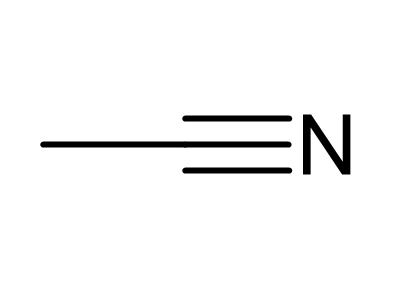
Acetonitrile is the simplest organic nitrile and consists of a methyl group directly bonded to a nitrile group. It is a highly polar aprotic solvent with a relatively small molecular size, low viscosity and substantial dipole moment. These characteristics give acetonitrile distinctive solvent properties and make it an important medium for chemical reactions, analytical separations, spectroscopy and electrochemical studies. Because it does not contain an acidic O–H or N–H group, acetonitrile does not act as a conventional hydrogen-bond donor, although the nitrogen atom of the nitrile group can participate in intermolecular interactions as an electron-pair acceptor.
Acetonitrile is extensively investigated in physical chemistry because its simple molecular structure provides a useful model for studies of molecular association, solvation, dielectric behavior, thermodynamics and liquid-state dynamics. Its mixtures with water and other organic solvents have been studied experimentally using density, viscosity, refractive-index, speed-of-sound and phase-equilibrium measurements. Acetonitrile is also frequently used as a nonaqueous medium in studies involving ions, coordination compounds and electrochemical reactions.
Chemical and physical properties
Acetonitrile is a volatile liquid under ambient conditions. NIST thermophysical data report an average normal boiling temperature of approximately 354.8 K, corresponding to about 81.7 °C. Its melting temperature is approximately 228 K, or about −45 °C.
The density of liquid acetonitrile is approximately 0.78 g/cm3 near room temperature. It also has a comparatively low dynamic viscosity, an important physicochemical property in applications where rapid mass transfer and low hydraulic resistance are required.
Acetonitrile is miscible with water under ordinary laboratory conditions and also mixes with numerous polar organic solvents. Detailed experimental studies of the acetonitrile–water system show that its phase behavior becomes more complex at low temperatures, demonstrating the strong temperature dependence of intermolecular interactions in this binary mixture.
Acetonitrile is a polar aprotic solvent. The strongly polarized carbon–nitrogen triple bond gives the molecule a significant dipole moment and enables effective solvation of many ionic and polar species. At the same time, the absence of conventional hydrogen-bond donor groups differentiates its solvent behavior from that of alcohols and water. These characteristics are important in reaction kinetics, ion-pair formation, coordination chemistry and electrochemical processes.
Thermochemical measurements reported for acetonitrile include an enthalpy of vaporization of approximately 33.2 kJ/mol at 298.15 K. Extensive vapor-pressure, phase-transition, gas-phase and condensed-phase thermodynamic data are available in the NIST Chemistry WebBook.
Applications
Acetonitrile is one of the most important organic solvents used in liquid chromatography. It is commonly employed as an organic component of mobile phases in reversed-phase high-performance liquid chromatography (RP-HPLC), ultra-high-performance liquid chromatography (UHPLC), liquid chromatography–mass spectrometry (LC–MS) and hydrophilic interaction liquid chromatography (HILIC). Its low viscosity can reduce chromatographic backpressure, while its solvent strength and miscibility with water allow mobile-phase composition to be adjusted over a wide range.
In HILIC, acetonitrile is particularly important because mobile phases commonly contain a high proportion of a water-miscible polar organic solvent together with a smaller aqueous fraction. Scientific reviews of HILIC methodology identify acetonitrile as one of the principal solvents used for controlling analyte retention and separation selectivity.
Acetonitrile is widely used as a reaction solvent in organic and inorganic synthesis. Its polar aprotic character makes it suitable for reactions involving ionic reagents, nucleophiles, transition-metal complexes and other polar intermediates. The relatively high polarity combined with weak proton-donating ability can substantially influence reaction rates, equilibria and selectivity.
It is also an important solvent in nonaqueous electrochemistry. Acetonitrile-based electrolytes have been studied in electrocatalysis, coordination electrochemistry and energy-storage research because the solvent can dissolve a variety of supporting electrolytes and provides a polar aprotic reaction environment. Scientific studies of electrochemical carbon dioxide conversion, for example, have used acetonitrile as a nonaqueous reaction medium to investigate solvent-dependent reaction pathways.
In physical and analytical chemistry, acetonitrile is used in spectroscopic measurements, extraction procedures, sample preparation and investigations of solvation phenomena. Its binary mixtures with water, alcohols, dimethyl sulfoxide and other solvents are frequently examined to understand excess thermodynamic properties, molecular interactions and transport behavior.
Scientific references
1. National Institute of Standards and Technology. NIST Chemistry WebBook, SRD 69: Acetonitrile, CAS 75-05-8. Thermochemical and phase-change data. https://webbook.nist.gov/cgi/cbook.cgi?ID=C75058
2. Putnam, W. E.; McEachern, D. M.; Kilpatrick, J. E. Entropy and Related Thermodynamic Properties of Acetonitrile (Methyl Cyanide). Journal of Chemical Physics, 1965, 42, 749–755. DOI: 10.1063/1.1696002. https://doi.org/10.1063/1.1696002
3. Aminabhavi, T. M.; Gopalakrishna, B. Density, Viscosity, Refractive Index, and Speed of Sound in Aqueous Mixtures of N,N-Dimethylformamide, Dimethyl Sulfoxide, N,N-Dimethylacetamide, Acetonitrile, Ethylene Glycol, Diethylene Glycol, 1,4-Dioxane, Tetrahydrofuran, 2-Methoxyethanol, and 2-Ethoxyethanol at 298.15 K. Journal of Chemical & Engineering Data, 1995, 40(4), 856–861. DOI: 10.1021/je00020a026. https://doi.org/10.1021/je00020a026
4. Buszewski, B.; Noga, S. Hydrophilic Interaction Liquid Chromatography (HILIC)—A Powerful Separation Technique. Analytical and Bioanalytical Chemistry, 2012, 402, 231–247. DOI: 10.1007/s00216-011-5308-5. https://doi.org/10.1007/s00216-011-5308-5
5. Szydłowski, J.; Szykuła, M. Experimental measurements of the acetonitrile–water system. Fluid Phase Equilibria, 1999, 154, 79. Data compiled in the IUPAC-NIST Solubility Database. https://srdata.nist.gov/solubility/sol_detail.aspx?sysID=78_9
6. An, X.; Månsson, M. Enthalpies of Combustion and Formation of Acetonitrile. Journal of Chemical Thermodynamics, 1983, 15, 287–293.
7. Howard, P. B.; Wadsö, I. Enthalpies of Vaporization of Organic Compounds IV. Alkyl Nitriles. Acta Chemica Scandinavica, 1970, 24, 145.
8. NORMAN Network authors. NORMAN Guidance on Suspect and Non-target Screening in Environmental Monitoring. Environmental Sciences Europe, 2023. The publication discusses chromatographic solvent selection, including the lower viscosity and chromatographic behavior of acetonitrile relative to methanol.
Safety

Signal Word: Danger
GHS Hazard Statements
H225 (> 99.9%): Highly Flammable liquid and vapor [Danger Flammable liquids]
H302 (99.8%): Harmful if swallowed [Warning Acute toxicity, oral]
H312 (94.3%): Harmful in contact with skin [Warning Acute toxicity, dermal]
H319 (99.8%): Causes serious eye irritation [Warning Serious eye damage/eye irritation]
H332 (95.1%): Harmful if inhaled [Warning Acute toxicity, inhalation]
Precautionary Statement Codes
P210, P233, P240, P241, P242, P243, P261, P264, P264+P265, P270, P271, P280, P301+P317, P302+P352, P303+P361+P353, P304+P340, P305+P351+P338, P317, P321, P330, P337+P317, P362+P364, P370+P378, P403+P235, and P501
Handling and Storage
Storage Conditions: Store in a tightly closed container in a cool, dry, and well-ventilated area away from heat sources and incompatible substances such as strong oxidizers.
Handling Precautions: Avoid inhalation and contact with skin and eyes. Use with adequate ventilation and proper protective equipment.



 Czysty >99% "Pin It")