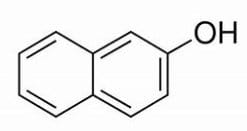
2-Naphthol
Other Names: β-Naphthol, Beta-naphthol, Naphthalen-2-ol, 2-Hydroxynaphthalene, 2-Naphthalenol, Naphth-2-ol
Chemical Formula: C10H8O
Molar Mass: 144.17 g/mol
CAS Number: 135-19-3
SMILES: c1ccc2cc(ccc2c1)O
Appearance: Colorless to white crystalline solid
Odor: Faint phenol-like odor
2-Naphthol is an aromatic organic compound belonging to the naphthol family and is one of the two principal monohydroxy derivatives of naphthalene. Its molecular structure consists of a fused bicyclic aromatic naphthalene system bearing a hydroxyl group at the 2-position. It is an isomer of 1-naphthol, differing only in the position of the hydroxyl substituent. The combination of an extended aromatic π-system and a phenolic hydroxyl group gives 2-naphthol characteristic acid-base, spectroscopic and hydrogen-bonding properties. The compound is frequently investigated as a model aromatic proton donor in studies of molecular association, solvent effects, fluorescence, excited-state proton transfer and hydrogen-bonded complexes.
Chemical and physical properties
2-Naphthol is a crystalline solid under ambient conditions. Experimental data report a melting point of approximately 121–123 °C and a boiling point of approximately 285 °C at atmospheric pressure. Its density is approximately 1.28 g/cm3 at 20 °C.
The compound has relatively low solubility in water. Experimental measurements report an aqueous solubility of approximately 0.755 g/L at 25 °C. It is considerably more soluble in many organic solvents, including ethanol, diethyl ether and chloroform.
2-Naphthol is a weakly acidic aromatic alcohol with a reported pKa of approximately 9.5. Under sufficiently alkaline conditions, deprotonation of the hydroxyl group produces the corresponding 2-naphthoxide anion. Formation of this anion strongly influences the electronic properties and chemical reactivity of the aromatic system.
The hydroxyl group of 2-naphthol participates readily in intermolecular hydrogen bonding. Spectroscopic studies have demonstrated hydrogen-bonded complexes between 2-naphthol and various proton-accepting molecules. The strength and geometry of these interactions influence its infrared absorption and electronic excitation and emission spectra.
2-Naphthol also exhibits pronounced solvent-dependent photophysical behavior. Fluorescence studies have shown that hydrogen bonding contributes substantially to its solvatochromic response. Electronic excitation strengthens the hydrogen-bond-donating interaction of the hydroxyl group with suitable solvent molecules, making 2-naphthol a useful molecular probe for studies of solvation and excited-state intermolecular interactions.
Applications
2-Naphthol is an important intermediate in organic synthesis. The activated aromatic system readily participates in electrophilic substitution reactions, while the phenolic hydroxyl group can undergo reactions characteristic of aromatic alcohols. Consequently, 2-naphthol is widely employed as a starting material for the preparation of substituted naphthalene derivatives and other aromatic compounds.
One particularly important reaction of 2-naphthol is azo coupling with aromatic diazonium compounds. Under suitable conditions, particularly when the naphthol is converted partially or completely into its more nucleophilic naphthoxide form, electrophilic coupling with diazonium species produces highly conjugated azo compounds. Scientific studies have investigated this reaction for the synthesis and functionalization of azo-containing molecular and polymeric materials.
In materials chemistry, 2-naphthol can be employed as an aromatic building block in the preparation and surface functionalization of organic materials. Azo coupling of 2-naphthol with immobilized diazonium groups has, for example, been investigated for chemical modification of polymeric and cellulose-based surfaces.
2-Naphthol is also extensively used as a model compound in physical and analytical chemistry. Its absorption and fluorescence properties enable investigations of solvent polarity, hydrogen bonding, molecular complex formation and excited-state proton-transfer processes. Spectroscopic studies of 2-naphthol complexes provide information about intermolecular interactions and structural changes occurring following electronic excitation.
In supramolecular and molecular spectroscopy research, 2-naphthol is particularly useful as a hydrogen-bond donor. Infrared and ultraviolet spectroscopic investigations of complexes with molecules such as anisole and amines have provided detailed information about hydrogen-bond geometries, conformational preferences and excited-state dynamics.
Scientific references
National Center for Biotechnology Information (NCBI), PubChem. 2-Naphthol, CID 8663. Chemical identity and physicochemical data including molecular formula, molecular mass, structure, melting point, boiling point, density and aqueous solubility.
Rettig, W.; Bliss, B.; Dirnberger, K. Solvatochromism of β-Naphthol. The Journal of Physical Chemistry A, 1998, 102(47), 9599–9606. DOI: 10.1021/jp982333c.
Nejad, A.; Pérez Mellor, A. F.; Lange, M.; Alata, I.; Zehnacker, A.; Suhm, M. A. Subtle hydrogen bond preference and dual Franck–Condon activity – the interesting pairing of 2-naphthol with anisole. Physical Chemistry Chemical Physics, 2023. DOI: 10.1039/D3CP00160A.
Ruostesuo, P.; Haapalainen, A. Hydrogen bonding of tris(diethylamino)phosphine oxide, tris(diethylamino)phosphine sulfide, tris(diethylamino)phosphine selenide and N,N-dimethylthioacetamide with various proton donors. Analyst, 1992, 117, 361–364. DOI: 10.1039/AN9921700361.
Matsumoto, Y.; Ebata, T.; Mikami, N. Characterizations of the hydrogen-bond structures of 2-naphthol-(H2O)n (n = 0–3 and 5) clusters by infrared-ultraviolet double-resonance spectroscopy. The Journal of Chemical Physics, 1998, 109. DOI: 10.1063/1.477272.
Functionalization of bead cellulose: azo coupling of diazotized 2-(4-aminophenylsulfonyl)ethyl derivative with 2-naphthol. Reactive Polymers, 1994, 22(2), 127–130. DOI: 10.1016/0923-1137(94)90143-0.
SAFETY 

Safety
Signal Word: Warning
Hazard Statements:
H302+H332: Harmful if swallowed or if inhaled.
H400: Very toxic to aquatic life.
Precautionary Statements:
P101: If medical advice is needed, have product container or label at hand.
P102: Keep out of reach of children.
P264: Wash hands and affected areas thoroughly after handling.
P271: Use only outdoors or in a well-ventilated area.
P391: Collect spillage.
P501: Dispose of contents/container to an authorized waste disposal facility or return to supplier.
First Aid Measures
Eye Contact: Rinse cautiously with water for several minutes. Remove contact lenses if present and easy to do. Continue rinsing. Seek medical attention if irritation occurs.
Skin Contact: Wash with soap and water. Remove contaminated clothing. Seek medical attention if irritation persists.
Inhalation: Remove victim to fresh air. If symptoms occur, seek medical advice.
Ingestion: Rinse mouth with water. Do not induce vomiting. Contact a poison control center or physician if feeling unwell.
Handling and Storage
Storage Conditions: Store in a cool, dry, and well-ventilated place. Protect from light and incompatible materials such as strong oxidizers.
Handling Precautions: Minimize dust formation. Avoid inhalation and contact with skin and eyes. Use appropriate personal protective equipment.



 "Pin It")