
 PRODUKTY
- ORGANICZNE(1103)
- Tiole(1)
- Związki metaloorganiczne(1)
- Alkohole(74)
- Aldehydy(43)
- Azotyny Alkilowe(6)
- Aminy(49)
- Aminokwasy(55)
- Amidy(33)
- Bezwodniki(11)
- Halogenki Kwasowe(5)
- Kwasy karboksylowe(166)
- Barwniki, wskaźniki(95)
- Estry(52)
- Etery(17)
- Halogenki(30)
- Flawonoidy(5)
- Heterocykle(24)
- Węglowodory(34)
- Imidy(1)
- Ketony(28)
- Rozpuszczalniki (premix)(16)
- Związki Nitrowe(7)
- Nitryle(9)
- Sole organiczne(73)
- Fenole(30)
- Polimery(64)
- Cukry(24)
- Związki krzemoorganiczne oraz fosforoorganiczne(1)
- Peptydy(2)
- Terpeny(16)
- Inne(127)
- NIEORGANICZNE(932)
- SPRZĘT LABORATORYJNY(5155)
- *(1)
- Synteza organiczna(373)
- Przemysł(741)
Wersje językowe
Wersja US umożliwia dostawę do wszystkich dostępnych destynacji.


 Producenci
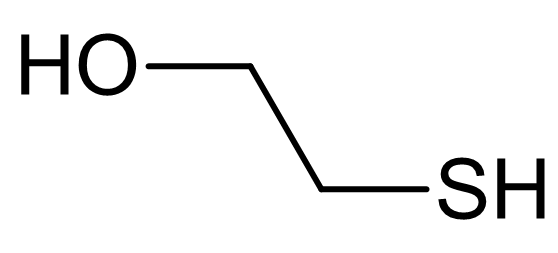
2-Merkaptoetanol 99% (tioglikol)
Cena regularna:
Cena regularna:
towar niedostępny
dodaj do przechowalni
0
 "Pin It")
Opis
2-Mercaptoethanol 99% (Thioglycol) – Liquid
Other Names: Thioglycol, 2-Hydroxyethyl mercaptan, β-Mercaptoethanol
CAS Number: 60-24-2
Sum Formula: C₂H₆OS
Molar Mass: 78.13 g/mol
Appearance: Colorless to pale yellow liquid with strong, unpleasant odor
2-Mercaptoethanol is a low-molecular-weight thiol compound widely used as a reducing agent in chemical synthesis and analytical laboratories. It has strong nucleophilic and antioxidant properties, commonly applied in redox chemistry and protein sample preparation.
Chemical and Physical Properties
-
Density: 1.11 g/cm³ (at 20°C)
-
Melting Point: -100°C
-
Boiling Point: 157°C
-
Solubility in Water: Miscible
-
Solubility in Other Solvents: Miscible with ethanol, acetone, chloroform
-
Odor: Strong, characteristic thiol odor
-
Vapor Pressure: ~0.5 mmHg (at 20°C)
Applications
-
Laboratory Use: Reducing agent for disulfide bonds in proteins and nucleic acids
-
Organic Synthesis: Intermediate and reagent in thiol and hydroxyl functionalization
-
Chemical Industry: Additive and stabilizer in polymer formulations, lubricants, and coatings
-
Analytical Chemistry: Sample preparation agent for SDS-PAGE and molecular biology protocols
Safety


Signal Word: Danger
H301 (53.5%): Toxic if swallowed [Danger Acute toxicity, oral]
H302 (45.9%): Harmful if swallowed [Warning Acute toxicity, oral]
H310 (44%): Fatal in contact with skin [Danger Acute toxicity, dermal]
H311 (55.4%): Toxic in contact with skin [Danger Acute toxicity, dermal]
H314 (32.4%): Causes severe skin burns and eye damage [Danger Skin corrosion/irritation]
H315 (66.8%): Causes skin irritation [Warning Skin corrosion/irritation]
H317 (56.2%): May cause an allergic skin reaction [Warning Sensitization, Skin]
H318 (66.5%): Causes serious eye damage [Danger Serious eye damage/eye irritation]
H331 (63.7%): Toxic if inhaled [Danger Acute toxicity, inhalation]
H332 (28%): Harmful if inhaled [Warning Acute toxicity, inhalation]
H361 (24.8%): Suspected of damaging fertility or the unborn child [Warning Reproductive toxicity]
H373 (51.8%): May causes damage to organs through prolonged or repeated exposure [Warning Specific target organ toxicity, repeated exposure]
H400 (59.6%): Very toxic to aquatic life [Warning Hazardous to the aquatic environment, acute hazard]
H410 (25.8%): Very toxic to aquatic life with long lasting effects [Warning Hazardous to the aquatic environment, long-term hazard]
H411 (70.8%): Toxic to aquatic life with long lasting effects [Hazardous to the aquatic environment, long-term hazard]
P203, P260, P261, P262, P264, P264+P265, P270, P271, P272, P273, P280, P301+P316, P301+P317, P301+P330+P331, P302+P352, P302+P361+P354, P304+P340, P305+P354+P338, P316, P317, P318, P319, P321, P330, P332+P317, P333+P317, P361+P364, P362+P364, P363, P391, P403+P233, P405, and P501
First Aid Measures
-
Eye Contact: Rinse with plenty of water for at least 15 minutes. Seek immediate medical attention
-
Skin Contact: Remove contaminated clothing. Rinse skin with water and soap
-
Inhalation: Move to fresh air. Seek medical attention if symptoms occur
-
Ingestion: Do not induce vomiting. Rinse mouth. Seek immediate medical help
Handling and Storage
-
Storage Conditions: Store tightly sealed in a well-ventilated, cool, dry area away from acids, oxidizers, and ignition sources
-
Handling Precautions: Avoid inhalation of vapors. Handle with proper PPE under fume hood or local exhaust ventilation