
 PRODUKTY
- ORGANICZNE(1030)
- Tiole(1)
- Związki metaloorganiczne(1)
- Kwasy sulfonowe(6)
- Alkohole(74)
- Aldehydy(37)
- Azotyny Alkilowe(6)
- Aminy(45)
- Aminokwasy(52)
- Amidy(29)
- Bezwodniki(12)
- Halogenki Kwasowe(5)
- Kwasy karboksylowe(157)
- Barwniki, wskaźniki(92)
- Estry(41)
- Etery(18)
- Halogenki(27)
- Flawonoidy(5)
- Heterocykle(21)
- Węglowodory(31)
- Imidy(2)
- Ketony(25)
- Rozpuszczalniki (premix)(13)
- Związki Nitrowe(7)
- Nitryle(9)
- Sole organiczne(73)
- Fenole(30)
- Polimery(56)
- Cukry(18)
- Związki krzemoorganiczne oraz fosforoorganiczne(1)
- Peptydy(2)
- Terpeny(12)
- Inne(124)
- NIEORGANICZNE(894)
- SPRZĘT LABORATORYJNY(5151)
- *(1)
- Synteza organiczna(354)
- Przemysł(708)
Wersje językowe
Wersja US umożliwia dostawę do wszystkich dostępnych destynacji.


 Producenci
1,2-dichloroetan (Chlorek etylenu)
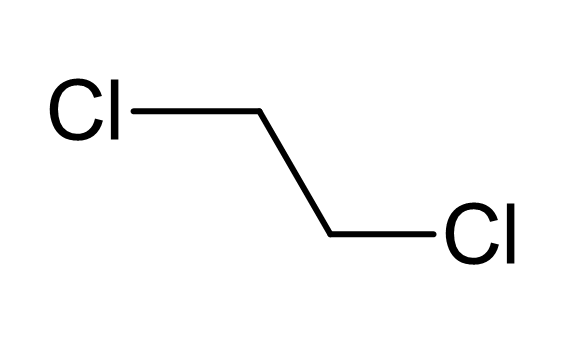
Cena regularna:
Cena regularna:
towar niedostępny
dodaj do przechowalni
0

 "Pin It")
Opis
Ethylene Chloride (1,2-Dichloroethane)
Other Names: Ethylene Dichloride, 1,2-Dichloroethane, Ethane-1,2-dichloride, Glycol Dichloride, sym-Dichloroethane, EDC, 1,2-DCE
Chemical Formula: C2H4Cl2
Molar Mass: 98.96 g/mol
CAS Number: 107-06-2
Appearance: Colorless, transparent liquid
Odor: Sweet, chloroform-like odor
SMILES: ClCCCl
Ethylene chloride, commonly known as 1,2-dichloroethane or ethylene dichloride, is a chlorinated aliphatic hydrocarbon consisting of two carbon atoms, each bonded to one chlorine atom. It belongs to the group of vicinal dihalogenated alkanes and is an important chemical intermediate in industrial organic chemistry. The presence of two carbon–chlorine bonds gives the molecule characteristic physicochemical properties and makes it suitable for a variety of chemical transformations. Ethylene chloride is particularly significant in the production of vinyl chloride monomer, a fundamental starting material for the manufacture of polyvinyl chloride (PVC).
Beyond its industrial importance, 1,2-dichloroethane has played a major role in the development of molecular conformational analysis. Early investigations of its dipole moment and spectroscopic properties provided important experimental evidence for the existence of different molecular conformations arising from rotation around a carbon–carbon single bond. Subsequent infrared, Raman and microwave spectroscopic studies demonstrated that the molecule can exist in trans and gauche conformations, with their relative populations depending on temperature, pressure and the surrounding medium. These characteristics have made 1,2-dichloroethane a frequently investigated model compound in physical chemistry, molecular spectroscopy, thermodynamics and computational chemistry.
Chemical and physical properties
Ethylene chloride is a colorless, volatile liquid under ambient conditions. Experimental and evaluated physicochemical data report a melting point of approximately −35.5 °C and a normal boiling point of approximately 83.5 °C.
Its density is approximately 1.245 g/cm3 at 25 °C, making it significantly denser than water. The vapor pressure is approximately 64 mmHg at 20 °C, indicating appreciable volatility under normal laboratory conditions.
1,2-Dichloroethane is only moderately soluble in water, with a reported solubility of approximately 8.6 g/L at 25 °C. It is miscible with several common organic solvents, including ethanol, diethyl ether and chloroform. Its combination of moderate polarity and solvent compatibility contributes to its usefulness in organic chemical processes.
The molecular structure of ethylene chloride permits internal rotation around the carbon–carbon single bond. Spectroscopic investigations have established the existence of trans and gauche conformers, whose relative stability depends on intermolecular interactions and the surrounding chemical environment. Raman and infrared spectroscopy have been used extensively to investigate these conformational equilibria, including their temperature- and pressure-dependent behavior.
The carbon–chlorine bonds can participate in nucleophilic substitution and elimination reactions under suitable conditions. Industrial thermal decomposition of 1,2-dichloroethane produces vinyl chloride and hydrogen chloride. The compound is also flammable, with a flash point of approximately 13 °C, and its vapors can form hazardous mixtures with air.
Applications
Ethylene chloride is primarily employed as a chemical intermediate in the manufacture of vinyl chloride monomer (VCM). Thermal cracking of 1,2-dichloroethane produces vinyl chloride, which is subsequently polymerized to form polyvinyl chloride (PVC). This process represents the most significant industrial application of ethylene dichloride and is a central component of chlorinated polymer production.
It is also used as an intermediate in the synthesis of other chlorinated organic compounds, including selected chlorinated solvents and chemical derivatives. Its molecular structure makes it relevant to industrial processes involving chlorination, dehydrochlorination and the transformation of halogenated hydrocarbons.
In organic synthesis, 1,2-dichloroethane is used as a solvent for selected chemical reactions, particularly where a relatively high-boiling chlorinated medium is required. Its solvent properties make it useful in research involving aromatic compounds, reaction mechanisms, catalytic transformations and the preparation of specialized organic intermediates.
Ethylene chloride is also relevant to the synthesis of certain nitrogen-containing compounds, including ethyleneamine derivatives. Its chemical reactivity allows it to function as a starting material in selected processes involving the formation of new carbon–nitrogen bonds.
In physical chemistry research, 1,2-dichloroethane serves as a model molecule for studying conformational equilibria, molecular dipole moments and solvent-dependent interactions. Raman, infrared and microwave spectroscopy, together with theoretical calculations, have been used to investigate its trans–gauche isomerization and the influence of temperature, pressure and solvent polarity on molecular structure.
It is additionally used as a reference compound in analytical chemistry and environmental research, particularly in studies of chlorinated volatile organic compounds, chromatographic separation, spectroscopic identification and the environmental behavior of halogenated hydrocarbons.
Safety information: Ethylene chloride is toxic, volatile and flammable. Exposure can adversely affect the central nervous system, liver and kidneys. The International Agency for Research on Cancer (IARC) classifies 1,2-dichloroethane as possibly carcinogenic to humans (Group 2B). The compound should be handled with appropriate ventilation, protective equipment and measures to prevent inhalation, skin contact and ignition.
Scientific references
- National Institute of Standards and Technology (NIST). NIST Chemistry WebBook, SRD 69: 1,2-Dichloroethane, CAS 107-06-2. Molecular structure, thermodynamic properties, boiling point, mass spectra and infrared spectroscopic data.
https://webbook.nist.gov/cgi/cbook.cgi?ID=C107062 - National Toxicology Program (2021). 15th Report on Carcinogens: 1,2-Dichloroethane. National Institute of Environmental Health Sciences. Chemical properties, industrial applications, toxicological investigations and carcinogenicity evaluation.
https://www.ncbi.nlm.nih.gov/books/NBK590794/ - International Agency for Research on Cancer (1999). 1,2-Dichloroethane. IARC Monographs on the Evaluation of Carcinogenic Risks to Humans, Volume 71. Physicochemical characteristics, industrial production, exposure and carcinogenicity.
https://www.ncbi.nlm.nih.gov/books/NBK498849/ - Discovery of internal rotation and conformers of 1,2-dichloroethane: the dawn of the concept of conformation. Proceedings of the Japan Academy, Series B, 100 (2024). Historical and scientific review of conformational analysis, molecular structure, dipole moments and spectroscopy.
https://doi.org/10.2183/pjab.100.003 - High-pressure induced conformational and phase transformations of 1,2-dichloroethane probed by Raman spectroscopy. The Journal of Physical Chemistry B (2007). Experimental investigation of pressure-dependent trans–gauche conformational equilibria and phase transitions.
https://doi.org/10.1021/jp068287v - Quantitative Determination of the Rotameric Energy Differences of 1,2-Dihaloethanes Using Raman Spectroscopy. An Experimental Project for the Physical Chemistry Laboratory. Journal of Chemical Education, 82 (2005), 912. Experimental Raman investigations of conformational energetics and solvent effects in 1,2-dihaloethanes.
https://doi.org/10.1021/ed082p912 - National Center for Biotechnology Information (NCBI). PubChem Compound Summary: 1,2-Dichloroethane, CID 11. Chemical identification, molecular formula, canonical SMILES, physicochemical characteristics and documented applications.
https://pubchem.ncbi.nlm.nih.gov/compound/11

Właściwości fizyczne i chemiczne
-
Gęstość:1.25 g/cm³ w 20°C
-
Temperatura topnienia:−35.3°C
-
Temperatura wrzenia:83.5°C
-
Rozpuszczalność w wodzie:Słabo rozpuszczalny (~8.7 g/L w 20°C)
-
Rozpuszczalność w innych rozpuszczalnikach:Miesza się z większością rozpuszczalników organicznych
-
Ciśnienie pary:~64 mmHg w 20°C
-
Temperatura zapłonu:13°C (zamknięty tygiel)
-
Temperatura samozapłonu:413°C
-
Granice wybuchowości:6.2–15.9% (w powietrzu)
-
Próg wyczuwalności zapachu:~10 ppm
Zastosowania
-
Produkcja chlorku winylu:Główne zastosowanie jako półprodukt pośredni w produkcji monomeru chlorku winylu (VCM), prekursora PVC.
-
Rozpuszczalnik:Stosowany do tłuszczów, olejów, wosków, żywic i kauczuku; także w klejach i powłokach.
-
Środek odtłuszczający:Używany do czyszczenia metalowych elementów w zastosowaniach przemysłowych.
-
Półprodukt chemiczny:Wykorzystywany w syntezie innych związków chlorowanych.
-
Odczynnik laboratoryjny:Sporadycznie stosowany w syntezie organicznej jako rozpuszczalnik.
Postępowanie i magazynowanie
-
Warunki przechowywania:Przechowywać w szczelnie zamkniętych pojemnikach, w chłodnym, suchym i dobrze wentylowanym miejscu, z dala od źródeł zapłonu oraz substancji niezgodnych (silne utleniacze, kwasy).
-
Środki ostrożności przy obchodzeniu się:Stosować odpowiednie środki ochrony indywidualnej (PPE). Unikać wdychania oraz kontaktu ze skórą i oczami. Pracować w dygestorium lub przy zapewnionej właściwej wentylacji.