
 PRODUKTY
- ORGANICZNE(1030)
- NIEORGANICZNE(894)
- Kwasy mineralne(40)
- Chelaty(2)
- Pierwiastki(115)
- Sole(509)
- Tlenki(119)
- Wodorotlenki(26)
- Wodorki(14)
- Inne(20)
- Nanocząstki(1)
- Roztwory mianowane(47)
- SPRZĘT LABORATORYJNY(5151)
- *(1)
- Synteza organiczna(354)
- Przemysł(708)
Wersje językowe
Wersja US umożliwia dostawę do wszystkich dostępnych destynacji.


 Producenci
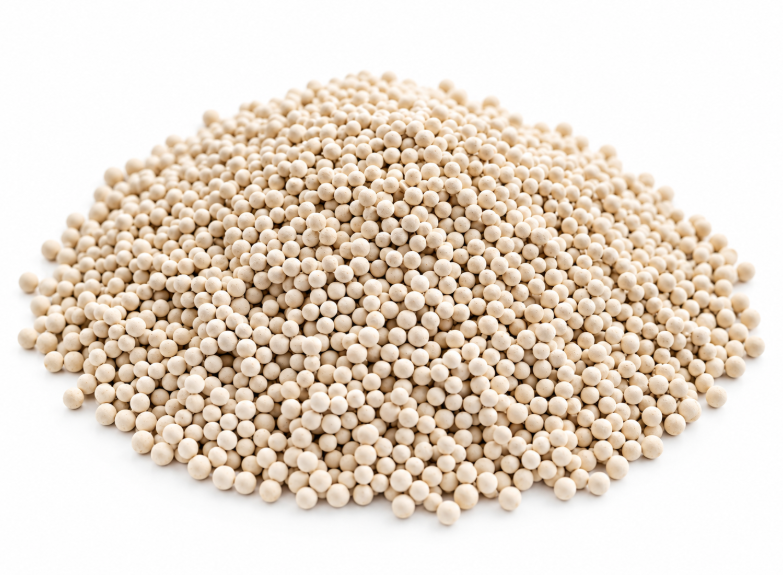
Sita molekularne 13X 3-5mm
Cena regularna:
Cena regularna:
towar niedostępny
dodaj do przechowalni
0


Opis
Molecular Sieves 13X
Other Names: Zeolite 13X, Sodium Zeolite X, NaX Zeolite, Faujasite-Type Molecular Sieve, Synthetic Faujasite X
Chemical Formula: Na86[(AlO2)86(SiO2)106] · xH2O (representative composition)
Molar Mass: Variable, depending on framework composition and hydration state
CAS Number: 63231-69-6
Appearance: White to off-white or pale beige crystalline powder, beads or granules
Odor: Odorless
Nominal Pore Size: Approximately 10 Å (1.0 nm); crystallographic framework window approximately 7.4 Å
Framework Type: FAU
SMILES: Not applicable (extended inorganic aluminosilicate framework without a unique molecular SMILES representation)
Molecular Sieves 13X are synthetic crystalline sodium aluminosilicate adsorbents belonging to the faujasite (FAU) zeolite family. They possess a three-dimensional microporous framework formed by interconnected silicon-oxygen and aluminium-oxygen tetrahedra. Their structure contains large internal cavities, commonly known as supercages, linked by twelve-membered oxygen-ring openings. This arrangement provides greater molecular accessibility than the smaller-pore LTA zeolites, allowing adsorption of a wider variety of gases and organic compounds. The framework carries negative charges arising from aluminium substitution, which are balanced primarily by sodium cations located within the pore system. These cations create strong electrostatic adsorption sites and contribute to the pronounced affinity of zeolite 13X for polar and polarizable molecules. Owing to its accessible pore network, high internal adsorption capacity and regenerable character, molecular sieve 13X is widely investigated for gas separation, carbon dioxide capture, industrial dehydration and chemical purification.
Chemical and physical properties
Molecular Sieves 13X are solid, microporous and crystalline materials characterized by the FAU framework topology. Their structure contains interconnected supercages with internal diameters of approximately 11–12 Å, linked through twelve-membered ring windows with crystallographic openings of approximately 7.4 Å. Commercial 13X materials are commonly described as having a nominal pore size of approximately 10 Å, although actual molecular accessibility depends on cation positions, molecular geometry and experimental conditions.
The material has a high internal surface area and substantial micropore volume. In an experimental investigation of zeolite 13X, nitrogen adsorption measurements gave a BET surface area of approximately 673 m2/g and a micropore volume of approximately 0.253 cm3/g. These values are sample-dependent and can vary with synthesis conditions, activation procedures and the presence of binders.
Molecular Sieves 13X exhibit strong affinity for water vapor and carbon dioxide. Adsorption of carbon dioxide is promoted by interactions between its molecular quadrupole and the electrostatic fields associated with the zeolite framework and sodium cations. This behavior contributes to selective carbon dioxide adsorption from gas mixtures containing nitrogen or methane.
Experimental studies have shown that zeolite 13X can exhibit substantial carbon dioxide adsorption capacity. Measurements on different materials have also demonstrated that pellet binders may partially obstruct micropores, reducing accessible surface area, adsorption capacity and diffusion rates.
Zeolite 13X is practically insoluble in water and common organic solvents. It is a nonflammable inorganic material that can be regenerated by thermal or pressure-swing desorption processes. Its effective adsorption capacity depends strongly on temperature, pressure, moisture content and competition between different adsorbed species.
Applications
Molecular Sieves 13X are extensively used in gas purification and dehydration systems. Their high affinity for water enables the removal of moisture from compressed air, industrial gases and selected hydrocarbon streams. The relatively large pore system also allows adsorption of molecules that cannot efficiently enter smaller-pore molecular sieves.
One of the most extensively investigated applications of zeolite 13X is carbon dioxide capture and separation. The material is used in adsorption-based processes designed to separate carbon dioxide from nitrogen-containing gas mixtures, natural gas streams and other industrial gas compositions. Its adsorption characteristics have been studied in pressure-swing and temperature-swing adsorption systems.
Molecular Sieves 13X are also investigated for the removal of sulfur-containing gases, including hydrogen sulfide, and for separation processes involving carbon dioxide, methane and nitrogen. Their relatively large adsorption cavities provide opportunities for the adsorption of various volatile organic compounds and larger organic molecules.
In laboratory and materials research, zeolite 13X is frequently used as a reference adsorbent for investigating adsorption isotherms, gas diffusion, surface interactions and separation selectivity. It is also studied in the development of structured adsorbents, supported zeolite materials and cyclic adsorption processes.
Scientific references
- Najafi, A. M. et al. "Effect of binder on CO2, CH4, and N2 adsorption behavior, structural properties, and diffusion coefficients on extruded zeolite 13X." Chemosphere, 324, 138275 (2023). https://doi.org/10.1016/j.chemosphere.2023.138275
- Azhagapillai, P. et al. "Water Vapor Adsorption Capacity Loss of Molecular Sieves 4A, 5A, and 13X Resulting from Methanol and Heptane Exposure." ACS Omega, 7, 6463–6471 (2022). https://doi.org/10.1021/acsomega.1c03370
- Tomadakis, M. M. et al. "Pressure-Swing Adsorption Separation of H2S from CO2 with Molecular Sieves 4A, 5A, and 13X." Separation Science and Technology, 46, 428–433 (2011). https://doi.org/10.1080/01496395.2010.520292
- Nguyen, H. G. T. et al. "A reference low-pressure CO2 adsorption isotherm for zeolite 13X: results of an interlaboratory study." Adsorption, 32 (2026). https://doi.org/10.1007/s10450-026-00701-3
- Hino, M. "Infrared Studies on Water Adsorption Systems with the Use of HDO. I. Molecular Sieves 13X and 4A." Bulletin of the Chemical Society of Japan, 50, 574–579 (1977). https://doi.org/10.1246/bcsj.50.574
- Canosa, E. "Adsorbents for Pollution Reduction in Cultural Heritage Collections." Swedish National Heritage Board, Research and Development Report (2019). Scientific report
SAFETY
This product is considered as non-hazardous