
 PRODUKTY
- ORGANICZNE(1220)
- NIEORGANICZNE(1075)
- SPRZĘT LABORATORYJNY(5155)
- *(1)
- Synteza organiczna(445)
- Przemysł(784)
Wersje językowe
Wersja US umożliwia dostawę do wszystkich dostępnych destynacji.


 Producenci
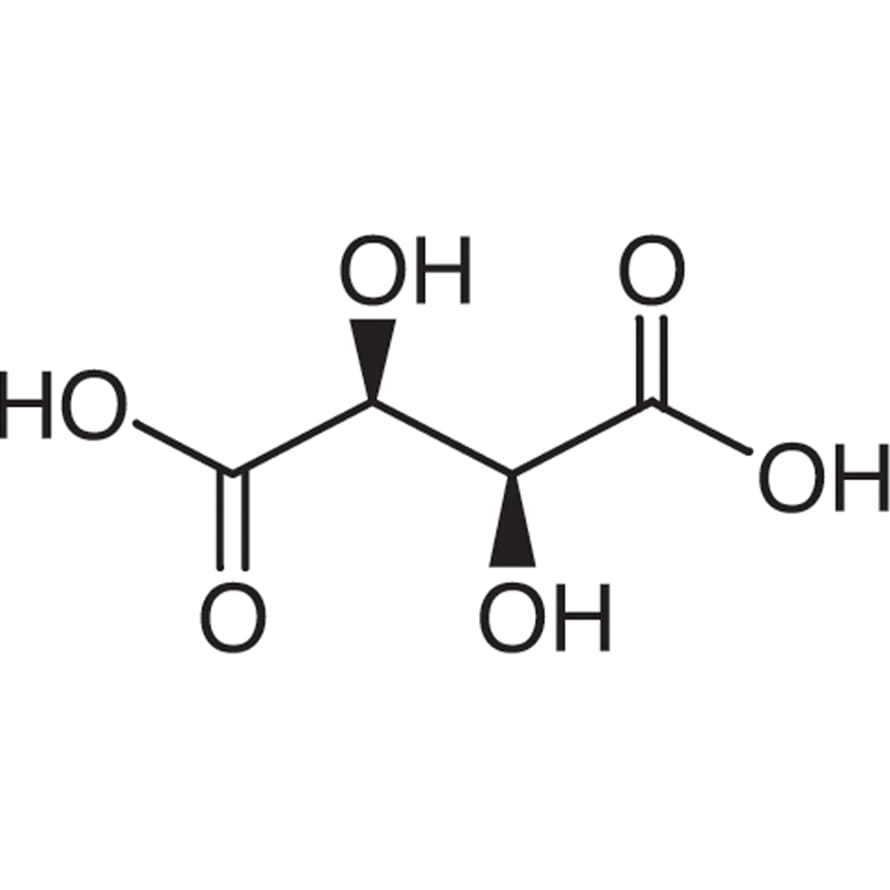
Kwas D-(-)-winowy
Cena regularna:
Cena regularna:
towar niedostępny
dodaj do przechowalni
0
-winowy "Pin It")
Opis
D-(−)-Tartaric acid
Other Names: (2S,3S)-(−)-Tartaric acid, D-Threaric acid
CAS Number: 147-71-7
Sum Formula: C₄H₆O₆
Molar Mass: 150.09 g/mol
Appearance: White crystalline powder
Tartaric acid is a naturally occurring alpha-hydroxy dicarboxylic acid. It contains two stereocenters and is widely used in industrial processes, especially in metal treatment, textile finishing, and as a chelating agent. It forms stable complexes with metal ions and is valued for its acidity and buffering capabilities in technical formulations.
Chemical and Physical Properties
Density: 1.79 g/cm³
Melting Point: ~170°C (decomposes)
Boiling Point: Not applicable (decomposes)
Solubility in Water: 139 g/L at 20°C
Solubility in Organic Solvents: Slightly soluble in ethanol; insoluble in non-polar solvents
pKa1: ~3.0 pKa2: ~4.3
Odor: Odorless
Form: Crystalline or powdered solid
Applications
Chelating agent in electroplating and metal cleaning formulations
Used in textile and leather finishing as a mordant or pH adjuster
Applied in ceramics and construction chemicals as a set retarder or dispersant
Intermediate in the synthesis of chiral compounds and catalysts
Used in analytical chemistry for complexometric titrations
Safety

Signal Word: Warning
H302 (42.5%): Harmful if swallowed [Warning Acute toxicity, oral]
H315 (54.3%): Causes skin irritation [Warning Skin corrosion/irritation]
H317 (42.5%): May cause an allergic skin reaction [Warning Sensitization, Skin]
H318 (41.2%): Causes serious eye damage [Danger Serious eye damage/eye irritation]
H319 (57.8%): Causes serious eye irritation [Warning Serious eye damage/eye irritation]
H335 (55.4%): May cause respiratory irritation [Warning Specific target organ toxicity, single exposure; Respiratory tract irritation]
First Aid Measures
Eye Contact: Rinse cautiously with water for several minutes. Seek medical attention if irritation persists
Skin Contact: Wash skin with soap and water. Remove contaminated clothing
Inhalation: Move to fresh air. Seek medical advice if symptoms develop
Ingestion: Rinse mouth. Do not induce vomiting unless advised by medical personnel
Handling and Storage
Store in a dry, well-ventilated area in tightly closed containers
Keep away from strong oxidizers and moisture
Use appropriate PPE to avoid eye and skin contact