
 PRODUKTY
- ORGANICZNE(1030)
- Tiole(1)
- Związki metaloorganiczne(1)
- Kwasy sulfonowe(6)
- Alkohole(74)
- Aldehydy(37)
- Azotyny Alkilowe(6)
- Aminy(45)
- Aminokwasy(52)
- Amidy(29)
- Bezwodniki(12)
- Halogenki Kwasowe(5)
- Kwasy karboksylowe(157)
- Barwniki, wskaźniki(92)
- Estry(41)
- Etery(18)
- Halogenki(27)
- Flawonoidy(5)
- Heterocykle(21)
- Węglowodory(31)
- Imidy(2)
- Ketony(25)
- Rozpuszczalniki (premix)(13)
- Związki Nitrowe(7)
- Nitryle(9)
- Sole organiczne(73)
- Fenole(30)
- Polimery(56)
- Cukry(18)
- Związki krzemoorganiczne oraz fosforoorganiczne(1)
- Peptydy(2)
- Terpeny(12)
- Inne(124)
- NIEORGANICZNE(894)
- SPRZĘT LABORATORYJNY(5151)
- *(1)
- Synteza organiczna(354)
- Przemysł(708)
Wersje językowe
Wersja US umożliwia dostawę do wszystkich dostępnych destynacji.


 Producenci
Glikol polietylenowy PEG 6000
Cena regularna:
Cena regularna:
towar niedostępny
dodaj do przechowalni
0


Opis
Polyethylene Glycol 6000 (PEG 6000)
Other Names: PEG 6000, Polyethylene Glycol 6000, Macrogol 6000, Poly(ethylene glycol), Polyoxyethylene Glycol, Polyethylene Oxide, Poly(oxyethylene), Polyglycol, PEG-6000
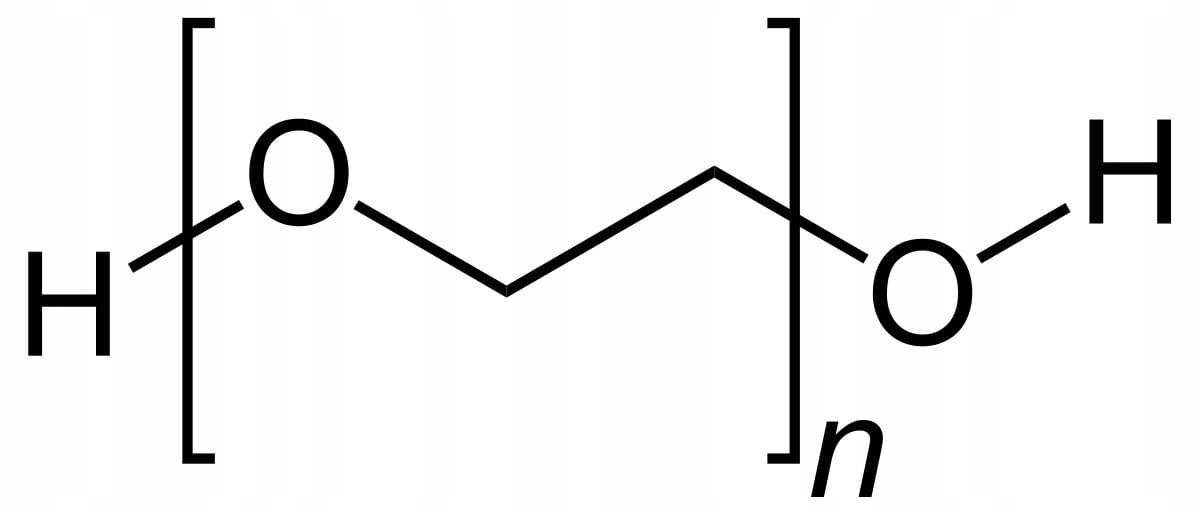
Chemical Formula: H(OCH2CH2)nOH (n ≈ 136)
Average Molar Mass: Approximately 6000 g/mol
CAS Number: 25322-68-3
EC Number: 500-038-2
Appearance: White to off-white waxy solid, typically supplied as powder, flakes or granules
Odor: Odorless or practically odorless
SMILES (Repeating Unit): [*]OCC[*]
Polyethylene Glycol 6000 (PEG 6000) is a hydrophilic, nonionic polyether polymer consisting of repeating ethylene oxide units connected by ether linkages and terminated by hydroxyl groups. It belongs to the polyethylene glycol family, whose physicochemical properties depend strongly on molecular weight, molecular weight distribution and polymer chain structure. The designation PEG 6000 refers to a polymer grade with an average molar mass of approximately 6000 g/mol rather than a single compound with an exact molecular weight. Consequently, commercial PEG 6000 consists of polymer chains with slightly different degrees of polymerization. Its molecular structure combines the hydrogen-bonding capability of ether oxygen atoms and terminal hydroxyl groups with the flexibility of an aliphatic polymer backbone. These structural features contribute to its excellent compatibility with water, low volatility, relatively low melting temperature and ability to interact with numerous organic and inorganic materials. PEG 6000 is widely investigated in polymer chemistry, pharmaceutical technology, biochemical separation, crystallization research and materials science. Its semicrystalline nature and reversible solid–liquid phase transition make it particularly valuable in the development of phase-change materials for thermal energy storage. It is also used as a hydrophilic polymer carrier in solid dispersions, a precipitating agent in protein purification and a functional additive in polymer membranes. The combination of water solubility, molecular flexibility and thermal properties makes PEG 6000 an important material in laboratory research and advanced industrial formulations.
Chemical and physical properties
PEG 6000 is a white to off-white waxy solid at room temperature. Published physicochemical data typically report a melting range of approximately 55–63 °C, although the exact transition temperature depends on molecular weight distribution, crystallinity and thermal history. Unlike a low-molecular-weight crystalline compound, PEG 6000 can exhibit complex melting behavior involving different crystalline populations and polymer chain arrangements.
Its density is approximately 1.2 g/cm3 at 20 °C. PEG 6000 has very low vapor pressure under ambient conditions because of its relatively high molecular mass. A conventional atmospheric boiling point is not generally applicable, as thermal degradation may occur before ordinary distillation becomes feasible.
PEG 6000 is highly soluble in water, forming clear or slightly opalescent solutions depending on concentration and material grade. Its excellent aqueous solubility results from the presence of numerous ether oxygen atoms capable of forming hydrogen bonds with surrounding water molecules. The terminal hydroxyl groups provide additional sites for intermolecular interactions. PEG 6000 is also compatible with certain polar organic solvents, although its solubility depends on solvent composition and temperature.
As a semicrystalline polymer, PEG 6000 contains both crystalline and amorphous regions. Scientific investigations using differential scanning calorimetry (DSC), optical thermal analysis and X-ray diffraction have demonstrated that its crystalline organization is strongly influenced by heating and cooling conditions. Rapid cooling can produce different structural arrangements compared with slow crystallization, resulting in changes in melting behavior and thermal transitions.
Experimental research has demonstrated that PEG 6000 can store significant quantities of thermal energy during melting and release this energy during crystallization. Published DSC measurements have reported melting enthalpies exceeding 200 J/g for certain PEG 6000 samples. In one investigation, the measured melting temperature was approximately 63.84 °C, with a melting enthalpy of 221.3 J/g. These values depend on sample characteristics and experimental conditions.
The polymer exhibits pronounced hydrogen-bonding interactions in aqueous solutions. The viscosity of PEG 6000 solutions increases with polymer concentration and is influenced by temperature and molecular weight distribution. At sufficiently high concentrations, chain interactions and molecular crowding can substantially affect solution flow and mass-transfer behavior.
PEG 6000 is a nonionic polymer and does not contain permanently charged functional groups along its backbone. Its terminal hydroxyl groups can undergo chemical modification through reactions such as esterification and urethane formation. These transformations enable the production of modified polyethylene glycol derivatives and the incorporation of PEG chains into more complex polymer networks.
Investigations of PEG 6000 phase transitions have demonstrated that its thermal behavior depends on the formation and rearrangement of crystalline lamellae and spherulitic structures. Research using calorimetric and optical techniques has identified multiple thermal events associated with melting, recrystallization and changes in polymer morphology. This structural behavior is important when selecting processing temperatures and cooling conditions for PEG-containing formulations.
Applications
PEG 6000 is extensively used as a functional polymer in pharmaceutical technology and solid dispersion research. Its hydrophilic character and relatively low melting temperature make it suitable for the preparation of polymer-based dispersions containing poorly water-soluble organic compounds. Research has demonstrated that PEG 6000 can improve the wetting and dissolution behavior of certain crystalline substances by modifying their dispersion state and interaction with aqueous media.
Experimental studies have investigated PEG 6000 as a polymer carrier in solid dispersions prepared through melting, solvent evaporation, spray drying and lyophilization. Research involving gliclazide demonstrated that dispersions prepared with PEG 6000 could increase the dissolution rate of the investigated compound. Additional studies involving nifedipine and sulfamethoxazole showed that PEG 6000-based dispersions enhanced dissolution behavior, although the results depended on the preparation technique, polymer composition and dissolution conditions.
In biochemical research, PEG 6000 is widely used as a precipitating and crystallization agent for proteins and other biological macromolecules. Its presence in aqueous solutions can reduce the effective solubility of selected proteins through excluded-volume and molecular crowding effects. By adjusting PEG concentration, temperature, pH and ionic strength, researchers can influence protein precipitation, crystallization and phase separation. PEG 6000 is particularly useful in crystallization screening experiments designed to produce crystals suitable for structural investigations using X-ray diffraction.
PEG 6000 is also employed in aqueous two-phase separation systems. Scientific research has demonstrated that mixtures containing PEG 6000 and potassium phosphate can form two aqueous phases suitable for the separation of proteins. A study using high-performance centrifugal partition chromatography successfully investigated the separation of bovine serum albumin and lysozyme in a PEG 6000–potassium phosphate system. Such applications are important in biochemical purification, analytical separation and downstream bioprocess development.
One of the most extensively investigated materials science applications of PEG 6000 is its use as a phase-change material (PCM) for thermal energy storage. The polymer absorbs thermal energy during melting and releases it during crystallization, enabling reversible heat storage over a temperature range close to its melting transition. Research has explored PEG 6000 in thermal management systems, solar thermal energy storage and heat-storage composites.
A study published in Solar Energy Materials and Solar Cells investigated the thermal and chemical stability of PEG 6000 over 1500 melting and freezing cycles. The researchers observed that its melting temperature remained relatively stable, although the latent heat of fusion gradually decreased during repeated cycling. Infrared spectroscopic analysis indicated that the principal chemical structure remained stable throughout the experiments. These findings demonstrated the potential of PEG 6000 as an organic phase-change material for thermal energy storage applications.
PEG 6000 is also used in the development of shape-stabilized composite phase-change materials. Research published in Polymers in 2023 described PEG 6000–silica composites containing multiwalled carbon nanotubes. The materials were designed to reduce leakage of molten PEG while maintaining favorable thermal energy storage properties. The optimized composite exhibited a phase-transition enthalpy of approximately 153 J/g and retained good stability during repeated thermal cycling. Such systems are investigated for advanced thermal management, energy storage and heat-transfer applications.
In membrane technology, PEG 6000 is investigated as a hydrophilic additive and pore-forming agent. Its incorporation into polymer casting solutions can influence membrane morphology, porosity, water permeability and separation performance. Research involving polyvinyl chloride-based membranes demonstrated that PEG molecular weight affects the internal structure and metal retention characteristics of the resulting membranes. In a 2024 study, membranes containing PEG 6000 exhibited increased porosity compared with analogous systems containing lower-molecular-weight PEG additives.
PEG 6000 is also investigated in polymer modification and composite materials research. Its flexible polyether chains and terminal hydroxyl groups enable interactions with other polymers, inorganic particles and functional surfaces. These properties make it suitable for developing composite materials with modified crystallinity, hydrophilicity and thermal characteristics.
In analytical and physicochemical research, PEG 6000 is used as a model semicrystalline polymer for investigations of molecular weight effects, polymer crystallization, thermal transitions and molecular interactions. Differential scanning calorimetry, Fourier-transform infrared spectroscopy, X-ray diffraction, thermogravimetric analysis and optical microscopy are frequently used to characterize its structure and behavior. These methods provide information about polymer crystallinity, thermal stability, intermolecular interactions and the effects of processing conditions.
PEG 6000 is additionally used in research on macromolecular crowding and protein phase behavior. The presence of polymer chains in aqueous systems can alter the thermodynamic environment of dissolved proteins and influence their association, precipitation and crystallization. These effects are particularly relevant to studies of protein solubility and the development of laboratory separation procedures.
Scientific references
1. Delahaye, N.; Duclos, R.; Saiter, J. M. (1997). Characterization of PEG6000 phase transitions: Influence of kinetic conditions. International Journal of Pharmaceutics, 157(1), 27–34. Experimental investigation of PEG 6000 crystallization, melting behavior, thermal history and polymer morphology using differential scanning calorimetry and optical thermal analysis.
https://doi.org/10.1016/S0378-5173(97)00207-X
2. Sharma, R. K.; Ganesan, P.; Tyagi, V. V.; Mahlia, T. M. I.; Mehrali, M. (2016). Accelerated thermal cycle and chemical stability testing of polyethylene glycol (PEG) 6000 for solar thermal energy storage. Solar Energy Materials and Solar Cells, 147, 235–239. Investigation of PEG 6000 thermal reliability, latent heat of fusion, chemical stability and performance after 1500 melting–freezing cycles.
https://doi.org/10.1016/j.solmat.2015.12.023
3. Nistor, C. L.; Gifu, I. C.; Anghel, E. M.; Ianchis, R.; Cirstea, C.-D.; Nicolae, C. A.; Gabor, A. R.; Atkinson, I.; Petcu, C. (2023). Novel PEG6000–Silica-MWCNTs Shape-Stabilized Composite Phase-Change Materials (ssCPCMs) for Thermal-Energy Storage. Polymers, 15(14), 3022. Experimental development of PEG 6000–silica–carbon nanotube composites and characterization of thermal energy storage capacity, crystallinity and cycling stability.
https://doi.org/10.3390/polym15143022
4. Biswal, S.; Sahoo, J.; Murthy, P. N.; Giradkar, R. P.; Avari, J. G. (2008). Enhancement of Dissolution Rate of Gliclazide Using Solid Dispersions with Polyethylene Glycol 6000. AAPS PharmSciTech, 9(2), 563–570. Research on PEG 6000 as a hydrophilic polymer carrier and its influence on solid dispersion formation, solubility and dissolution properties.
https://doi.org/10.1208/s12249-008-9079-z
5. Altamimi, M. A.; Neau, S. H. (2017). Investigation of the in vitro performance difference of drug-Soluplus and drug-PEG 6000 dispersions when prepared using spray drying or lyophilization. Saudi Pharmaceutical Journal, 25(3), 419–439. Comparative investigation of PEG 6000-based solid dispersions, crystallinity, dissolution characteristics and polymer–compound interactions.
https://doi.org/10.1016/j.jsps.2016.09.013
6. McPherson, A.; Cudney, B. (2014). Optimization of crystallization conditions for biological macromolecules. Acta Crystallographica Section F: Structural Biology Communications, 70, 1445–1467. Scientific discussion of polyethylene glycol precipitants, including PEG 6000, and their application in protein crystallization and crystal-growth optimization.
https://doi.org/10.1107/S2053230X14019670
7. Chen, J.; Ma, G. X.; Li, D. Q. (1999). HPCPC separation of proteins using polyethylene glycol-potassium phosphate aqueous two-phase. Preparative Biochemistry & Biotechnology, 29(4), 371–383. Experimental investigation of protein separation using PEG 6000–potassium phosphate aqueous two-phase systems and centrifugal partition chromatography.
https://doi.org/10.1080/10826069908544935
8. Yildiz, Y.; Manzak, A. (2024). The Effect of a Hydrophilic Polymer on the Morphology of Polymeric Membranes and the Retention of Metals. Water, Air, & Soil Pollution, 235, Article 517. Investigation of PEG 6000 as a hydrophilic membrane additive and its influence on polymer membrane porosity, morphology and metal retention.
https://doi.org/10.1007/s11270-024-07324-w
9. Radaev, S.; Li, S.; Sun, P. D. (2006). A survey of protein–protein complex crystallizations. Acta Crystallographica Section D: Biological Crystallography, 62, 605–612. Analysis of crystallization conditions for protein complexes, including the frequent use of polyethylene glycol precipitants in the molecular weight range of 5000–6000.
https://doi.org/10.1107/S0907444906011735
Safety
Signal Word: None
Hazard Statements:
None
Precautionary Statements:
None
First Aid Measures
Eye Contact: Rinse thoroughly with water for several minutes. Seek medical attention if irritation persists.
Skin Contact: Wash with soap and water. Remove contaminated clothing and seek medical attention if irritation occurs.
Inhalation: Move to fresh air. Seek medical help if symptoms persist.
Ingestion: Rinse mouth with water. Do not induce vomiting. Seek medical advice if feeling unwell.
Handling and Storage
Storage Conditions: Store in a cool, dry, well-ventilated area, away from moisture and incompatible materials.
Handling Precautions: Avoid contact with eyes, skin, and clothing. Use appropriate personal protective equipment, such as gloves and goggles.