
 PRODUKTY
- ORGANICZNE(1115)
- Tiole(1)
- Związki metaloorganiczne(1)
- Alkohole(74)
- Aldehydy(43)
- Azotyny Alkilowe(6)
- Aminy(55)
- Aminokwasy(55)
- Amidy(33)
- Bezwodniki(11)
- Halogenki Kwasowe(5)
- Kwasy karboksylowe(167)
- Barwniki, wskaźniki(95)
- Estry(52)
- Etery(17)
- Halogenki(30)
- Flawonoidy(5)
- Heterocykle(25)
- Węglowodory(38)
- Imidy(1)
- Ketony(29)
- Rozpuszczalniki (premix)(16)
- Związki Nitrowe(7)
- Nitryle(9)
- Sole organiczne(73)
- Fenole(30)
- Polimery(64)
- Cukry(24)
- Związki krzemoorganiczne oraz fosforoorganiczne(1)
- Peptydy(2)
- Terpeny(16)
- Inne(126)
- NIEORGANICZNE(1022)
- SPRZĘT LABORATORYJNY(5155)
- *(1)
- Synteza organiczna(416)
- Przemysł(767)
Wersje językowe
Wersja US umożliwia dostawę do wszystkich dostępnych destynacji.


 Producenci
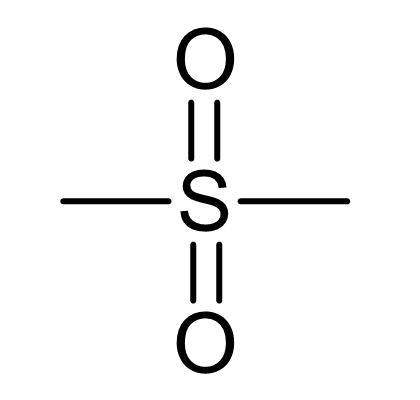
Dimetylosulfon (MSM) metylosulfonylometan
Cena regularna:
Cena regularna:
towar niedostępny
dodaj do przechowalni
0

 metylosulfonylometan "Pin It")
Opis
Dimethyl Sulfone (MSM)
Other Names: Methylsulfonylmethane, MSM, Dimethyl sulfone, Methyl sulfone, Sulfonylbismethane
Chemical Formula: C2H6O2S
Molar Mass: 94.13 g/mol
CAS Number: 67-71-0
SMILES: CS(=O)(=O)C
Appearance: Colorless to white crystalline solid
Odor: Odorless
Dimethyl sulfone (MSM) is a small organosulfur compound containing a sulfone functional group bonded to two methyl groups. It is the fully oxidized sulfone analogue of dimethyl sulfoxide (DMSO). The sulfur atom is bonded to two oxygen atoms through strongly polarized S–O interactions, giving the molecule a substantial dipole moment and allowing the oxygen atoms to function as hydrogen-bond acceptors. MSM occurs as a stable crystalline material under ambient conditions and is frequently studied as a model compound for investigations of sulfone structure, molecular interactions, phase behavior, spectroscopy and organosulfur chemistry.
Chemical and physical properties
Dimethyl sulfone is a colorless to white crystalline solid with a molar mass of approximately 94.13 g/mol. Experimental measurements generally place its melting point at approximately 108–110 °C. At atmospheric pressure, its boiling point is reported at approximately 238 °C, although sublimation and vapor-phase behavior can become relevant depending on experimental conditions.
MSM is soluble in water and its aqueous solubility is strongly temperature dependent. The polar sulfone group interacts with surrounding water molecules through hydrogen-bonding interactions, while the two methyl groups provide comparatively nonpolar regions of the molecule.
The sulfone functional group is considerably more oxidized than the corresponding sulfoxide group in DMSO. Oxidation of DMSO can therefore produce dimethyl sulfone, and this transformation has been investigated in atmospheric, environmental and laboratory oxidation chemistry.
Dimethyl sulfone possesses a relatively symmetrical molecular structure. Its vibrational and rotational properties have consequently been examined using infrared, Raman and microwave spectroscopy. These investigations provide information about S–C and S–O bonding, molecular geometry, internal methyl-group rotation and intermolecular interactions in the crystalline and gaseous states.
MSM is a polar compound capable of acting as a hydrogen-bond acceptor through its sulfonyl oxygen atoms. In the solid state, crystal packing is influenced by electrostatic interactions and weak intermolecular contacts involving the strongly polarized sulfone functionality.
Applications
Dimethyl sulfone is used as a reagent and reference compound in organic and organosulfur chemistry. Its chemically stable sulfone group makes it useful in investigations of the structural, spectroscopic and physicochemical properties of low-molecular-weight sulfones.
In synthetic chemistry, the methyl groups adjacent to the sulfonyl functionality can participate in reactions after appropriate activation. Dimethyl sulfone and related sulfones have therefore been investigated as building blocks and methylsulfonyl-containing reagents in carbon–carbon bond-forming transformations and other synthetic methodologies.
MSM is used in analytical and spectroscopic research as a model sulfone. Infrared, Raman, rotational and nuclear magnetic resonance techniques have been applied to investigate its molecular structure, vibrational modes, conformational properties and intermolecular interactions.
Dimethyl sulfone is also relevant to atmospheric and environmental chemistry because it can be formed through oxidation pathways involving reduced sulfur compounds, including dimethyl sulfoxide and related organosulfur species. Laboratory studies of these processes contribute to understanding the transformation and distribution of sulfur-containing organic compounds.
Because MSM forms a well-defined crystalline phase and exhibits characteristic thermal transitions, it has also been investigated in thermodynamic, calorimetric and phase-equilibrium studies. Measurements of its melting behavior, vapor pressure, heat capacity and related properties provide reference data for research involving molecular crystals and organosulfur compounds.
Scientific references
National Center for Biotechnology Information (NCBI), PubChem. Dimethyl Sulfone, CID 6213. Chemical identity and physicochemical information including molecular formula, molecular mass, structure, melting point, boiling point and solubility.
Clark, T.; Murray, J. S.; Lane, P.; Politzer, P. Why are dimethyl sulfoxide and dimethyl sulfone such good solvents? Journal of Molecular Modeling, 2008, 14, 689–697. DOI: 10.1007/s00894-008-0279-y.
Allinger, N. L.; Kao, J. Molecular structures of dimethyl sulfoxide and dimethyl sulfone. Journal of the American Chemical Society. Structural investigations of bonding and molecular geometry in low-molecular-weight sulfur compounds.
Takeuchi, H.; Harada, I. Vibrational spectra and normal coordinate analysis of dimethyl sulfone. Spectrochimica Acta Part A: Molecular Spectroscopy. Spectroscopic investigation of the characteristic vibrational modes and molecular structure of dimethyl sulfone.
National Institute of Standards and Technology (NIST). NIST Chemistry WebBook: Dimethyl sulfone, CAS 67-71-0. Experimental thermochemical, phase-change and spectroscopic data for dimethyl sulfone.
Safety
Signal Word: None
Hazard Statements: None
Precautionary Statements: None required
First Aid Measures
Eye Contact: If in eyes, rinse cautiously with water for several minutes. Seek medical attention if irritation persists.
Skin Contact: Wash skin with soap and water. Remove contaminated clothing.
Inhalation: Move to fresh air. Seek medical help if symptoms persist.
Ingestion: Rinse mouth with water. Seek medical attention if feeling unwell.
Handling and Storage
Storage Conditions: Store in a cool, dry place, away from moisture and incompatible materials.
Handling Precautions: Handle with care, use appropriate personal protective equipment.