
 PRODUKTY
- ORGANICZNE(1030)
- NIEORGANICZNE(894)
- SPRZĘT LABORATORYJNY(5151)
- *(1)
- Synteza organiczna(354)
- Przemysł(708)
Wersje językowe
Wersja US umożliwia dostawę do wszystkich dostępnych destynacji.


 Producenci
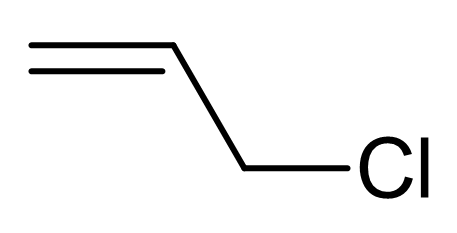
Chlorek allilu
Cena regularna:
Cena regularna:
towar niedostępny
dodaj do przechowalni
0

Opis
Allyl Chloride
Other Names: 3-Chloropropene, 1-Chloro-2-propene
CAS Number: 107-05-1
Sum Formula: C₃H₅Cl
Molar Mass: 76.53 g/mol
Appearance: Colorless to slightly yellow liquid
Allyl chloride is an organohalogen compound featuring a reactive allyl group and a chlorine atom. It is a volatile and flammable liquid primarily used as an intermediate in the production of polymers, resins, and plasticizers, as well as in the synthesis of various chemical compounds containing allyl functionality.
Chemical and Physical Properties
Density: 0.94 g/cm³
Melting Point: -134°C
Boiling Point: 44.5°C
Solubility in Water: Slightly soluble (~3.5 g/L at 20°C)
Solubility in Organic Solvents: Miscible with alcohols, ethers, benzene, and chloroform
Vapor Pressure: 460 hPa at 20°C
Flash Point: -28°C (closed cup)
Autoignition Temperature: ~416°C
Explosion Limits: 2.8–31 vol% in air
Odor: Pungent, acrid
Applications
Used in the production of epichlorohydrin, allyl alcohol, and allylamine
Intermediate in the synthesis of specialty resins, adhesives, and surfactants
Applied in organic synthesis involving alkylation and polymer functionalization
Used in laboratory and industrial chemical processes as a reactive halide
Safety

Signal Word: Danger
H225: Highly Flammable liquid and vapor [Danger Flammable liquids]
H302: Harmful if swallowed [Warning Acute toxicity, oral]
H312: Harmful in contact with skin [Warning Acute toxicity, dermal]
H315: Causes skin irritation [Warning Skin corrosion/irritation]
H319: Causes serious eye irritation [Warning Serious eye damage/eye irritation]
H332: Harmful if inhaled [Warning Acute toxicity, inhalation]
H335: May cause respiratory irritation [Warning Specific target organ toxicity, single exposure; Respiratory tract irritation]
H341: Suspected of causing genetic defects [Warning Germ cell mutagenicity]
H351: Suspected of causing cancer [Warning Carcinogenicity]
H373 **: May causes damage to organs through prolonged or repeated exposure [Warning Specific target organ toxicity, repeated exposure]
H400: Very toxic to aquatic life [Warning Hazardous to the aquatic environment, acute hazard]
P203, P210, P233, P240, P241, P242, P243, P260, P261, P264, P264+P265, P270, P271, P273, P280, P301+P317, P302+P352, P303+P361+P353, P304+P340, P305+P351+P338, P317, P318, P319, P321, P330, P332+P317, P337+P317, P362+P364, P370+P378, P391, P403+P233, P403+P235, P405, and P501
First Aid Measures
Eye Contact: Rinse immediately with plenty of water for at least 15 minutes. Seek medical attention
Skin Contact: Remove contaminated clothing and wash skin thoroughly with soap and water
Inhalation: Move to fresh air immediately. If symptoms persist, seek medical advice
Ingestion: Rinse mouth with water. Do not induce vomiting. Seek medical help promptly
Handling and Storage
Store in a flammable-liquids cabinet, in a tightly closed container
Keep away from sources of ignition, heat, oxidizers, and moisture
Ensure adequate ventilation during handling; use explosion-proof equipment
Use PPE including gloves, chemical goggles, and respiratory protection if needed