
 PRODUKTY
- ORGANICZNE(1115)
- Tiole(1)
- Związki metaloorganiczne(1)
- Alkohole(74)
- Aldehydy(43)
- Azotyny Alkilowe(6)
- Aminy(55)
- Aminokwasy(55)
- Amidy(33)
- Bezwodniki(11)
- Halogenki Kwasowe(5)
- Kwasy karboksylowe(166)
- Barwniki, wskaźniki(95)
- Estry(52)
- Etery(17)
- Halogenki(30)
- Flawonoidy(5)
- Heterocykle(25)
- Węglowodory(38)
- Imidy(1)
- Ketony(29)
- Rozpuszczalniki (premix)(16)
- Związki Nitrowe(7)
- Nitryle(9)
- Sole organiczne(73)
- Fenole(30)
- Polimery(64)
- Cukry(24)
- Związki krzemoorganiczne oraz fosforoorganiczne(1)
- Peptydy(2)
- Terpeny(16)
- Inne(127)
- NIEORGANICZNE(932)
- SPRZĘT LABORATORYJNY(5155)
- *(1)
- Synteza organiczna(377)
- Przemysł(741)
Wersje językowe
Wersja US umożliwia dostawę do wszystkich dostępnych destynacji.


 Producenci
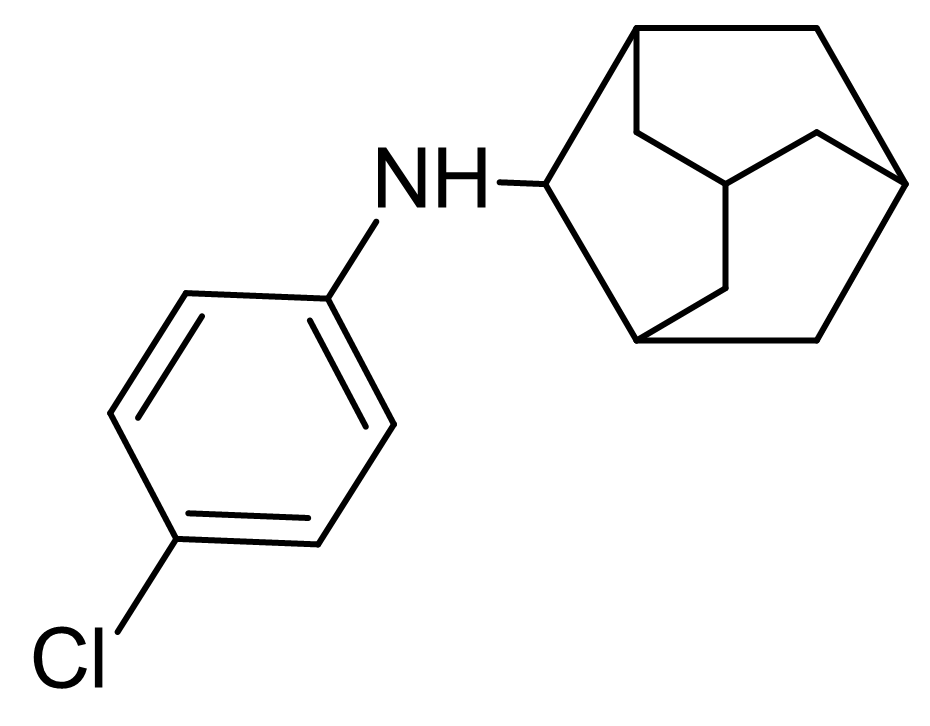
Chlomantan (N-(4-chlorofenylo)adamantan-2-amina)
Cena regularna:
Cena regularna:
towar niedostępny
dodaj do przechowalni
0
adamantan-2-amina) "Pin It")
Opis
N-(4-Chlorophenyl)adamantan-2-amine
Other Names: N-(4-Chlorophenyl)-2-adamantanamine, 2-(4-Chloroanilino)adamantane, bromantane chlorine analogue
Chemical Formula: C16H20ClN
Molar Mass: 261.79 g/mol
CAS Number: Not reliably assigned in the consulted scientific literature
SMILES: C1C2CC3CC1CC(C2)C3NC4=CC=C(C=C4)Cl
We are pleased to introduce a novel research compound that, to the best of our knowledge, has not yet been pharmacologically investigated.
Previous research on bromantane analogues supports continued investigation of structural modifications within this class of compounds. In particular, Orlinson B.S. et al. reported the synthesis and in vivo pharmacological evaluation of new conformationally labile bromantane analogues and demonstrated that their biological activity profiles were strongly dependent on the nature of substitution within the adamantane moiety. These findings indicate that structural modification of bromantane-related compounds may result in derivatives with distinct biological properties and justify further structure–activity relationship studies.
Due to its structural relationship to bromantane and other adamantane derivatives, the compound may be of particular interest to pharmaceutical companies, academic institutions, and research laboratories conducting studies in medicinal chemistry, pharmacology, structure–activity relationships, and drug discovery.
The product is offered as a research material intended to support further scientific investigation, including evaluation of its biological activity, pharmacological profile, physicochemical properties, and potential applications in pharmaceutical research.
We encourage interested research institutions and pharmaceutical-sector partners to undertake further studies of this compound and assess its scientific and potential therapeutic relevance.
For research use only. No pharmacological, clinical, or therapeutic efficacy is claimed.
This product is not intended for in vivo research. Any in vivo use requires prior testing by an independent research laboratory, all necessary ethical, institutional, and regulatory approvals, and full compliance with applicable laws and research standards.
For research use only. No pharmacological, therapeutic, or clinical efficacy is claimed.
Suspicious purchases that appear unrelated to legitimate scientific or research purposes may be canceled.
N-(4-Chlorophenyl)adamantan-2-amine is a secondary aromatic amine containing a rigid adamantan-2-yl group attached through nitrogen to a para-chlorinated phenyl ring. The molecule combines the three-dimensional, highly constrained hydrocarbon framework of adamantane with an electron-deficient chlorophenyl substituent. This structural arrangement makes the compound useful for investigations of adamantane-containing aromatic amines, palladium-catalyzed carbon–nitrogen bond formation and the influence of bulky cage substituents on the properties of arylamines.
The compound has been reported in studies of palladium-catalyzed amination of dihalobenzenes with aminoadamantanes. In the published synthesis, adamantan-2-amine was reacted with 1-bromo-4-chlorobenzene using a palladium catalyst and BINAP ligand in the presence of sodium tert-butoxide. Selective substitution of the bromine atom produced N-(4-chlorophenyl)adamantan-2-amine while retaining the chlorine substituent on the aromatic ring. The reported isolated yield was 83%, demonstrating effective chemoselective formation of the aryl–nitrogen bond.
Chemical and physical properties
Molecular formula, C16H20ClN, corresponds to a calculated average molar mass of approximately 261.79 g/mol.
Mass-spectrometric characterization by MALDI-TOF gave a molecular ion at m/z 261.08, consistent with the molecular composition of the chlorinated adamantane-derived arylamine.
The reported 1H NMR spectrum contains signals characteristic of the adamantane framework in the approximately 1.60–2.00 ppm region. A signal associated with the carbon bonded to nitrogen appears further downfield, while the para-substituted aromatic ring gives two characteristic doublets at approximately 6.51 and 7.09 ppm.
The 13C NMR spectrum contains resonances at approximately 27.2, 27.3, 31.4, 31.5, 37.3, 37.6 and 56.8 ppm for the adamantane-derived carbon atoms. Aromatic carbon signals were reported at approximately 114.0, 121.0, 129.0 and 145.8 ppm. The carbon at approximately 56.8 ppm corresponds to the adamantane carbon directly associated with the amino substituent.
The molecule contains one secondary amino group capable of acting as a hydrogen-bond donor and acceptor. Its adamantane moiety provides a rigid, hydrophobic cage structure, while the para-chlorophenyl group contributes aromatic character and an aryl chloride functionality that may be useful in further synthetic transformations.
Applications
N-(4-Chlorophenyl)adamantan-2-amine is primarily relevant as a research compound and synthetic intermediate in organic and medicinal chemistry. It can be used as a model substrate for studying palladium-catalyzed aryl amination, particularly chemoselective reactions involving aromatic compounds containing two different halogen substituents.
The retained para-chloro substituent provides a potential site for subsequent functionalization, allowing the compound to serve as an intermediate in the preparation of more highly substituted adamantane-containing aromatic amines.
The compound is also of interest in structure–property studies involving adamantane derivatives. The rigid adamantane framework is frequently incorporated into research molecules to investigate how bulky three-dimensional hydrocarbon groups influence molecular conformation, hydrophobicity, intermolecular interactions and physicochemical behavior.
Scientific references
Averin, A. D.; Ulanovskaya, M. A.; Kovalev, V. V.; Buryak, A. K.; Orlinson, B. S.; Novakov, I. A.; Beletskaya, I. P. “Palladium-Catalyzed Amination of Isomeric Dihalobenzenes with 1- and 2-Aminoadamantanes.” Russian Journal of Organic Chemistry, 2010, 46(1), 64–72. DOI: 10.1134/S1070428010010069.
National Center for Biotechnology Information. PubChem Compound Summary for Adamantan-2-amine, CID 25332. Structural and molecular data for the adamantan-2-amine framework.
Potential Synthetic Adaptogens. II. Synthesis and Pharmacological Activity of New Conformationally Labile Bromantane Analogs, N-[(Adamantan-1-yl)methyl]-4-bromoanilines, Pharmaceutical Chemistry Journal, 2017, 50(12), 781–787.
Safety

Signal Word: Warning
H315 (100%): Causes skin irritation [Warning Skin corrosion/irritation]
H319 (100%): Causes serious eye irritation [Warning Serious eye damage/eye irritation]
H335 (100%): May cause respiratory irritation [Warning Specific target organ toxicity, single exposure; Respiratory tract irritation]
P261, P264, P264+P265, P271, P280, P302+P352, P304+P340, P305+P351+P338, P319, P321, P332+P317, P337+P317, P362+P364, P403+P233, P405, and P501
First Aid Measures
-
Eye Contact: Rinse thoroughly with water. Seek medical advice if irritation continues
-
Skin Contact: Wash with soap and water. Remove contaminated clothing
-
Inhalation: Move to fresh air. Seek medical attention if symptoms occur
-
Ingestion: Rinse mouth. Do not induce vomiting. Seek medical advice
Handling and Storage
-
Storage Conditions: Store in a tightly closed container in a cool, dry, and well-ventilated place. Protect from heat, moisture, and direct light
-
Handling Precautions: Avoid formation of dust. Use personal protective equipment and operate in ventilated conditions
Koszty dostawy
Cena nie zawiera ewentualnych kosztów płatności
Produkty powiązane
Bromantan

Cena netto: 40,65 zł
Chlodantan

Cena netto: 48,78 zł