
 PRODUKTY
- ORGANICZNE(1115)
- Tiole(1)
- Związki metaloorganiczne(1)
- Alkohole(74)
- Aldehydy(43)
- Azotyny Alkilowe(6)
- Aminy(55)
- Aminokwasy(55)
- Amidy(33)
- Bezwodniki(11)
- Halogenki Kwasowe(5)
- Kwasy karboksylowe(167)
- Barwniki, wskaźniki(95)
- Estry(52)
- Etery(17)
- Halogenki(30)
- Flawonoidy(5)
- Heterocykle(25)
- Węglowodory(38)
- Imidy(1)
- Ketony(29)
- Rozpuszczalniki (premix)(16)
- Związki Nitrowe(7)
- Nitryle(9)
- Sole organiczne(73)
- Fenole(30)
- Polimery(64)
- Cukry(24)
- Związki krzemoorganiczne oraz fosforoorganiczne(1)
- Peptydy(2)
- Terpeny(16)
- Inne(126)
- NIEORGANICZNE(1022)
- SPRZĘT LABORATORYJNY(5155)
- *(1)
- Synteza organiczna(416)
- Przemysł(767)
Wersje językowe
Wersja US umożliwia dostawę do wszystkich dostępnych destynacji.


 Producenci
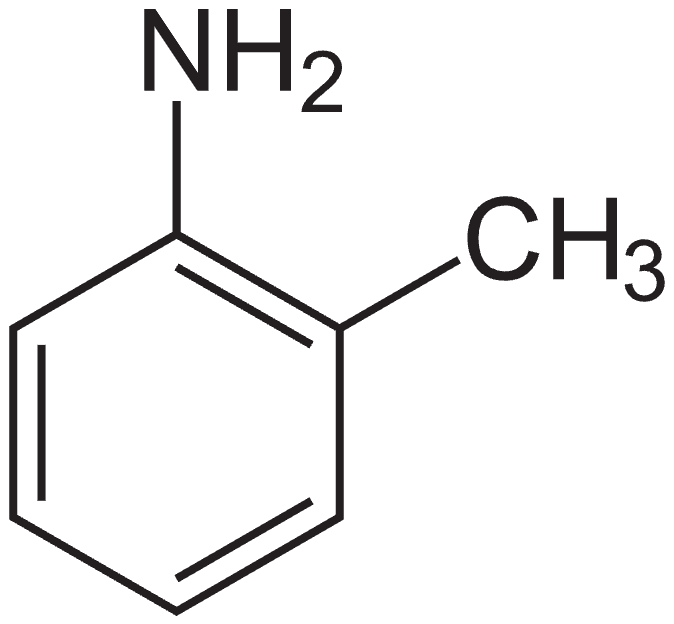
2-metyloanilina ( o-toluidyna )
Cena regularna:
Cena regularna:
towar niedostępny
dodaj do przechowalni
0
 "Pin It")
Opis
2-Methylaniline
Other Names: o-Toluidine, ortho-Toluidine, 2-Methylbenzenamine, 2-Aminotoluene, o-Methylaniline
Chemical Formula: C7H9N
Molar Mass: 107.15 g/mol
CAS Number: 95-53-4
Appearance: Colorless to pale yellow liquid; may gradually become reddish-brown on exposure to air and light
2-Methylaniline, commonly known as o-toluidine, is an aromatic primary amine structurally derived from aniline by the introduction of a methyl group adjacent to the amino group on the benzene ring. The ortho arrangement of the methyl and amino substituents influences the electronic and steric properties of the molecule and distinguishes it from the corresponding meta- and para-toluidine isomers. It is an important chemical intermediate and is also investigated as a model substituted aromatic amine in studies of reaction mechanisms, electrochemistry, spectroscopy and polymer formation.
Chemical and physical properties
2-Methylaniline is a liquid under normal ambient conditions. Reference data report a boiling point of approximately 200–202 °C. The compound exhibits low-temperature solid-state polymorphism, with reported melting points of approximately −24.4 °C for the alpha form and −16 °C for the beta form.
Its density is approximately 0.998 g/cm3 at 20 °C, making it close in density to water. The compound is only moderately soluble in water; experimental data report a water solubility of approximately 16.6 g/L at 25 °C. It is considerably more soluble in common organic solvents and in dilute acids, where protonation of the amino group increases its affinity for polar media.
The amino group acts as a basic and chemically reactive site, whereas the aromatic ring undergoes substitution reactions characteristic of activated aromatic amines. The neighboring methyl substituent introduces steric effects around the amino group and modifies the electronic distribution of the aromatic system. These structural characteristics are important in synthetic chemistry and in studies comparing the reactivity of positional toluidine isomers.
Applications
2-Methylaniline is used primarily as an intermediate in organic synthesis, particularly in the manufacture of dyes, pigments and specialty aromatic compounds. It is also employed as an intermediate in the preparation of chemicals used in synthetic rubber production and rubber-processing chemistry.
In materials science and electrochemistry, 2-methylaniline can undergo oxidative polymerization to form poly(o-toluidine), a substituted conducting polymer. Poly(o-toluidine) and related copolymers have been investigated as functional materials for electrochemical sensors, energy-storage systems and protective coatings. The methyl substituent alters the morphology, conductivity and electrochemical behavior of the resulting polymer relative to unsubstituted polyaniline.
2-Methylaniline is additionally used in laboratory research involving aromatic amine oxidation, electrode reactions, molecular interactions and spectroscopic characterization. Its defined substitution pattern makes it useful for investigating how steric and electronic effects influence the properties and reactivity of aromatic amines.
Safety information
2-Methylaniline requires strict handling precautions because of its toxicological properties. The International Agency for Research on Cancer (IARC) classifies o-toluidine as carcinogenic to humans (Group 1), with sufficient evidence linking occupational exposure to urinary bladder cancer. Scientific evaluations also describe metabolic activation, formation of DNA adducts and DNA-damaging effects as relevant mechanisms. Appropriate engineering controls, personal protective equipment and procedures minimizing inhalation and skin exposure are therefore necessary when handling this substance.

Signal Word: Danger
H301: Toxic if swallowed [Danger Acute toxicity, oral]
H319: Causes serious eye irritation [Warning Serious eye damage/eye irritation]
H331: Toxic if inhaled [Danger Acute toxicity, inhalation]
H350: May cause cancer [Danger Carcinogenicity]
H400: Very toxic to aquatic life [Warning Hazardous to the aquatic environment, acute hazard]
P203, P261, P264, P264+P265, P270, P271, P273, P280, P301+P316, P304+P340, P305+P351+P338, P316, P318, P321, P330, P337+P317, P391, P403+P233, P405, and P501
First Aid Measures
Eye Contact: Rinse immediately with water for at least 15 minutes. Seek medical attention
Skin Contact: Remove contaminated clothing. Wash with soap and water
Inhalation: Move to fresh air. Provide oxygen if needed. Seek medical attention immediately
Ingestion: Do not induce vomiting. Rinse mouth and seek urgent medical care
Handling and Storage
Store in tightly closed containers in a cool, dry, well-ventilated place
Protect from light and air to prevent oxidation
Keep away from acids, oxidizing agents, and strong bases
Use only in fume hoods with appropriate PPE